
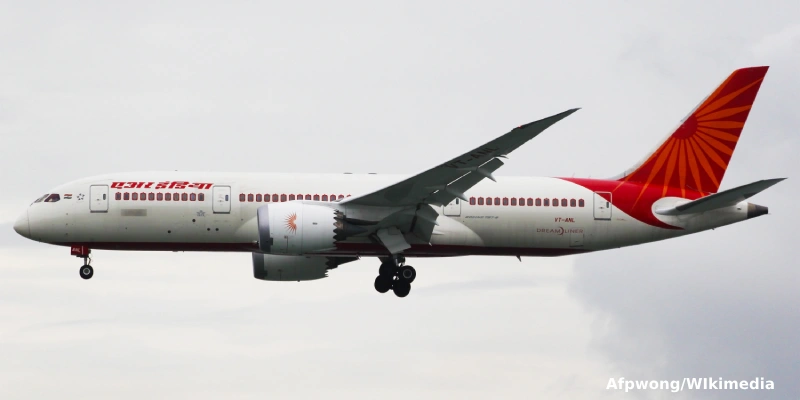
Air India Group has registered a record loss exceeding $2.5 billion during its fiscal year 2025-2026. This historic financial setback is primarily driven by severe operational disruptions triggered by the war in Iran and Pakistan’s ban on Indian airlines utilizing its airspace.
Singapore Airlines Financial Report Reveals Magnitude of the Deficit
According to the annual report published by Singapore Airlines (SIA), which holds a 25% stake in Air India, the Indian group’s losses escalated to 3.56 billion Singapore dollars. This figure equates to $2.8 billion US dollars at the current exchange rate. These results surpass previous estimates, which had anticipated a negative balance of over $2.12 billion.
This balance sheet represents a profound deterioration compared to fiscal year 2024-2025, a period in which Air India reported a standalone loss of $415 million and a consolidated deficit of $1.13 million when including its low-cost subsidiary Air India Express. To date, Air India—which is not publicly traded on the Indian stock exchange and has not filed its financial statements with local regulators—has declined to comment on the matter.
Key Factors Behind the Historic Deficit: Operational Challenges and Headwinds
The auditing firm KPMG, in a report included within SIA’s disclosures, highlighted the existence of “impairment indicators” regarding the investment in Air India, citing challenging operating conditions and high geopolitical uncertainty.
→ Air India Strengthens North American Presence Through Interline Agreement with WestJet
SIA detailed a series of critical factors in a statement that are currently hindering the recovery of the Tata Group-owned carrier:
- Airspace Restrictions: The direct impact of the conflict in Iran and Pakistan’s overflight ban have severely restricted viable flight routing.
- Global Supply Issues: Supply chain constraints that continue to impact the normal operations and development of the global industry.
- Pressure in Key Markets: Sharp operational limitations across the Middle East, one of its core geographical markets.
- Surging Fuel Costs: High aviation fuel prices driven by the conflict in Iran, a pressure that SIA warns will intensify and weigh more heavily over the coming year.
Compounding these macroeconomic factors is the intense oversight and public scrutiny the airline has faced following last year’s tragic Boeing 787 crash in Gujarat, India, which resulted in 260 fatalities.
Impact on Restructuring Plans and Windfall for Competitors
The massive losses have forced Air India to cut dozens of international routes in recent months, dealing a severe blow to Tata Group’s restructuring and stabilization plans.
However, this drastic reduction in operations by the flag carrier has proven highly beneficial for foreign operators. Major international airline groups, such as the Lufthansa Group and Cathay Pacific, have capitalized on the situation by increasing frequencies and adding services to India, further consolidating the country’s position as one of the fastest-growing aviation markets worldwide.
Long-Term Commitment in a Volatile Environment
Despite the complex financial outlook and warnings from auditors, Singapore Airlines categorically reaffirmed its ongoing commitment to its strategic investment in the Indian group. The Singaporean carrier also reported a 57.4% decline in its own annual profits due to the impact of fuel costs; however, this drop was less severe than initially anticipated by the industry.
Related Topics

British Airways Unveils New Cabins for Airbus A380 Fleet as Part of Multi-Million Pound Customer Experience Investment

LOT Polish Airlines Launches Direct Flights Between Warsaw and Bangkok
Lufthansa Group Boosts Connectivity to Japan, Reaching Up to 50 Weekly Flights in Summer 2027

British Airways Launches Multi-Million-Pound Heathrow Airport Lounge Transformation


Plataforma Informativa de Aviación Comercial con 13 años de trayectoria.