
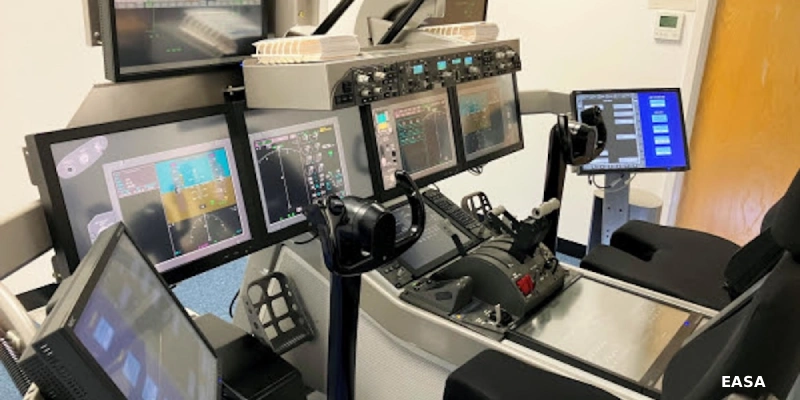
The European Union Aviation Safety Agency (EASA) has introduced a new regulatory framework for Flight Simulation Training Devices (FSTDs), marking the most profound and significant evolution in flight simulation qualification on the European continent in decades. This structural update aims to address rapid technological advancements and optimize technical instruction processes across the commercial aviation industry.
The new regulatory framework, established under Regulation (EU) 2026/781 and backed by the newly issued Certification Specifications (CS-FSTD Issue 1), completely modernizes the criteria by which simulation devices are evaluated, certified, and operated by training organizations and airlines. The core objective is to inject adaptability into the training system, aligning it with contemporary digital innovations and the sector’s emerging operational needs.
From a Rigid Model to Capability-Based Qualification
FSTDs play a critical role in global civil aviation safety, enabling flight crews to train, practice, and maintain their competencies under high-fidelity scenarios and realistic conditions. In addition to boosting the pedagogical effectiveness of instruction, simulation drastically reduces airlines’ environmental impact and completely mitigates the risks associated with real-world flight operations during practical training exercises.
The major shift in this reform lies in replacing the traditional qualification approach—historically anchored in fixed, standardized simulator levels and types—with a flexible, capability-based system. Under this new premise, simulation devices will be audited and qualified according to their actual and demonstrable technical capabilities. This provides a scalable ecosystem capable of evolving organically alongside tomorrow’s simulation technologies.
“Flight simulation has transformed pilot training over the past decades and will continue to play a central role in the future of aviation. The new framework creates a modern and flexible system that reflects what training devices can actually do, rather than how they have been traditionally categorized. It supports innovation, enables the integration of new technologies into training, and helps ensure that pilots continue to receive highly effective, high-quality training in a constantly evolving aviation environment.”
— Francesco Gaetani, EASA Flight Standards Director
→ EASA Orders Special Inspections on Select Airbus A380s Over Wing Crack Risk
Pillars of Innovation: FCS and the “Task-to-Tool” Methodology
At the core of this regulatory overhaul is the new FSTD Capability Signature (FCS). This is a standardized, uniform method designed to precisely describe the performance of each simulation device using explicit simulation features and defined technical fidelity levels.
Additionally, the regulatory framework officially opens the door to cutting-edge technologies by introducing specific qualification requirements and development guidelines for disruptive technological solutions. Key among these innovations are the formal integration of touch-screen flight deck interfaces and advanced Extended Reality (XR) applications within regulated flight crew instruction.
Another operational milestone of the regulation is the inclusion of the optional “task-to-tool” training methodology. This procedure directly empowers Approved Training Organizations (ATOs) and airline operators to surgically select the ideal simulation device for specific training objectives. This methodology provides unprecedented strategic flexibility in training curriculum design, optimizing financial and technical resources without ever compromising current rigorous aviation safety standards.
Key Pillars of EASA’s New Regulatory Framework:
- Capability-Based Qualification System: A system based on the actual technical capabilities of each simulation device, replacing rigid classifications.
- FSTD Capability Signature (FCS): Introduced as a uniform descriptor standard for equipment performance.
- Touch-Screen Flight Deck Interfaces: Specific qualification provisions tailored to modern touch-screen flight decks.
- Extended Reality (XR): Clear regulations and tailored guidance material for the safe use of XR technologies.
- Optional “Task-to-Tool” Methodology: Implementation of this framework to bring strategic flexibility to airline and ATO curriculum design.
- Scalable Regulatory Architecture: Designed to natively support and adapt to future simulation technology developments.
Rollout Timeline and Industry Implementation Support
Mindful of the technical and operational impact this transition imposes on European airlines and training centers, EASA has designed a far-reaching practical implementation support program. This industry-wide initiative includes the publication of informative guidance material, a specialized support manual, and a comprehensive schedule of workshops and roundtables tailored to the sector’s various stakeholders and operators.
According to the official timeline established by the European agency, the interactive workshop cycle will commence at the end of this year, 2026, and run throughout 2027. The first international general information briefing is scheduled for December 15, 2026, at EASA’s headquarters in Cologne, Germany, marking the official launch of a new era in flight crew training and certification for the region.
Related Topics

Embraer Reports Record Third-Quarter Performance With 66 Aircraft Delivered
Embraer Nears Key Regional Jet Order from Japan Airlines

BermudAir Becomes Second Global Operator of Embraer E-Freighter

ANA Expands Regional Fleet with Additional Order for Eight Embraer E190-E2s


Un apasionado por la aviación, Fundador y CEO de Aviación al Día.