
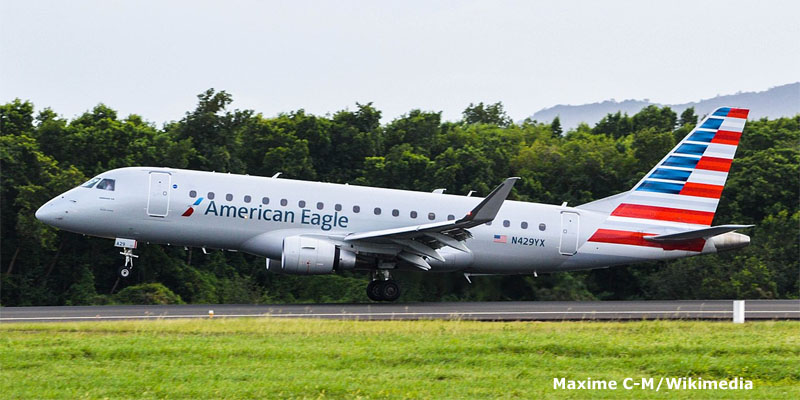
American Airlines and Infinium have successfully completed the first delivery and operational utilization of electro-sustainable aviation fuel (eSAF) on a commercial passenger flight within the United States. The operation, conducted between Corpus Christi International Airport (CRP) and Dallas/Fort Worth International Airport (DFW), marks the first direct integration of a non-biobased SAF into the common-use distribution infrastructure of a commercial U.S. airport.
Logistics Integration and Technical Certification Under ASTM Standards
The synthetic fuel used on this flight was produced and blended at Infinium’s Pathfinder facility in Corpus Christi, Texas. In operation since 2023, Pathfinder established itself as the world’s first commercial-scale facility dedicated to producing eFuels via power-to-liquid (PtL) conversion processes.
To guarantee seamless operation without requiring modifications to the aircraft or ground fueling infrastructure, the batch of eSAF was formulated and rigorously tested:
- Blending and Certification: The eSAF was combined with conventional jet fuel until it fully complied with ASTM International specifications for Jet A.
- Supply Chain: Following certification, the batch was injected into CRP’s shared fuel storage tanks and subsequently assigned to the American Airlines aircraft.
- Drop-in Compatibility: The trial confirmed the full technical viability of distributing synthetic fuels through standard commercial aviation logistics and fueling systems.
→ American Airlines Resumes Direct Flights Between Miami and Maracaibo, Venezuela
Production Process and Carbon Footprint Reduction
Unlike traditional sustainable aviation fuels derived from biomass or used cooking oils, Infinium’s eSAF is synthesized exclusively from waste carbon dioxide ($\text{CO}_2$) and electricity from renewable sources.
This technology allows for a drastic mitigation of the sector’s environmental impact:
- Emissions Reduction: Infinium’s eSAF reduces lifecycle greenhouse gas (GHG) emissions by more than 90% compared to conventional petroleum-based jet fuel.
“Since 2023, we have been producing scalable eDiesel and eNaphtha at our Pathfinder facility using waste carbon and renewable energy for use in commercial trucking and plastics processing. Adding eSAF to our product portfolio—and seeing it power a commercial passenger flight—marks another significant step forward in delivering practical, low-carbon fuel solutions to the industry.”
— Robert Schuetzle, Chief Executive Officer at Infinium.
Scalability of Production: Project Roadrunner
As part of its sustainability strategy, American Airlines maintains a commercial off-take agreement to purchase future volumes of eSAF from Project Roadrunner, Infinium’s new large-scale production facility.
The initiative is also supported by Citi through a structured agreement designed to facilitate the reduction of Scope 3 emissions associated with its corporate business travel.
Key Facts on Project Roadrunner:
- Financing: Backed by Breakthrough Energy Catalyst and Brookfield Asset Management, along with non-recourse project debt provided by HSBC.
- Timeline: Currently under construction, commercial production and deliveries of eSAF are scheduled to begin in 2027.
- Projected Capacity: Once operating at full capacity, the plant will produce over 5 million gallons of eSAF per year.
“This flight represents a significant moment for aviation. Through our partnership with Infinium, we are demonstrating how next-generation technologies like eSAF can move from early investment to real-world application. Scaling SAF production at lower prices is essential to reducing emissions, strengthening our long-term competitiveness, and continuing to deliver the connectivity and economic benefits our customers rely on.”
— Robert Isom, Chief Executive Officer (CEO) at American Airlines.
Global Industry Context and Energy Sovereignty
Global commercial aviation consumes nearly 100 billion gallons of fuel annually, transporting over 4 billion passengers. Despite progress toward environmental targets, sustainable aviation fuel currently accounts for less than 1% of total global consumption.
Scalable drop-in replacement fuels like eSAF represent one of the most immediate tools to reduce emissions without requiring near-term fleet fleet overhauls or modifications. Furthermore, they enhance energy security by diversifying national supply matrices.
Industry Outlook
This flight marks eSAF’s operational transition from the development and innovation stages to real-world implementation on commercial routes. The operation sets a key precedent for the widespread adoption of electro-sustainable fuels as a pathway to accelerating the energy transition in international commercial aviation.
Related Topics
British Airways Unveils New Cabins for Airbus A380 Fleet as Part of Multi-Million Pound Customer Experience Investment
LOT Polish Airlines Launches Direct Flights Between Warsaw and Bangkok
Lufthansa Group Boosts Connectivity to Japan, Reaching Up to 50 Weekly Flights in Summer 2027

British Airways Launches Multi-Million-Pound Heathrow Airport Lounge Transformation


Plataforma Informativa de Aviación Comercial con 13 años de trayectoria.