
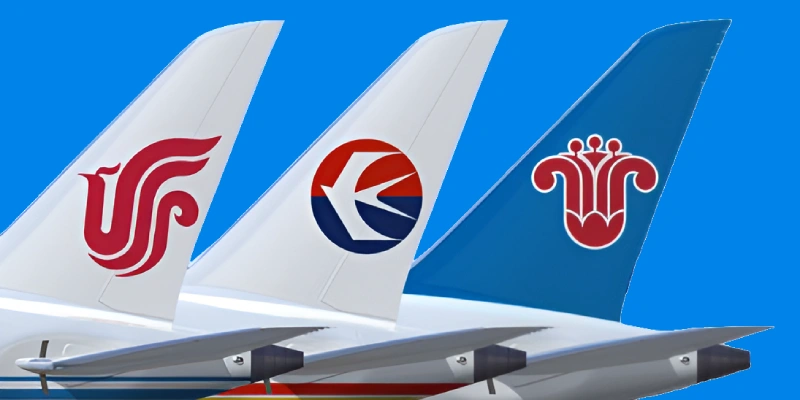
Air China, China Eastern Airlines, and China Southern Airlines have suffered major financial losses driven by surging jet fuel prices and sluggish domestic yields, while an unusually severe summer typhoon season continues to batter operations.
The three state-owned flag carriers of the People’s Republic of China reported a combined net loss of approximately 8.2 billion yuan (around USD 1.22 billion) for the first half of the year. The results mark the seventh consecutive year of H1 losses for the state transport group, sharply reversing first-quarter profits—where they achieved a combined net profit of 4.82 billion yuan fueled by Lunar New Year travel—and dragging down stock prices across both Shanghai and Hong Kong exchanges.
Losses by Airline
- Air China: The flag carrier posted a net loss of 2.3 billion yuan, deepening the 1.81 billion yuan deficit reported in the same period last year.
- China Eastern Airlines: Reported a net loss of 2.2 billion yuan, compared to a net loss of 1.43 billion yuan logged in the first half of 2025.
- China Southern Airlines: Suffered the heaviest hit, reporting a net loss of 3.7 billion yuan, up from a 1.53 billion yuan loss in the previous period.
During H1, jet fuel operating expenses surged between 35% and 38% across all three carriers. Unlike international competitors in Asia and Europe, Chinese airlines maintain low-coverage or limited fuel hedging strategies. In a regulatory filing, China Southern Airlines noted that it currently lacks effective hedging instruments to mitigate exposure to crude oil volatility, with prices remaining more than 50% above pre-conflict levels.
→ Chinese Firms Lead Shortlist for Ethiopian Airlines’ New Mega-Airport in Addis Ababa
Operating Revenue and Passenger Traffic
Despite negative bottom-line results, top-line revenue remained in positive territory, bolstered by international demand:
- Air China: 10.5% revenue growth.
- China Eastern Airlines: 11.1% revenue growth.
- China Southern Airlines: 9.7% revenue growth.
European routes showed strong performance, driven by travelers avoiding Middle Eastern hubs disrupted by the ongoing armed conflict with Iran. Domestically, however, broader economic weakness and intense competition from high-speed rail (HSR) and road transport limited the carriers’ ability to raise yields without dampening local demand.
Operational Weather Disruptions
The third quarter, historically the highest operational margin period for Chinese commercial aviation, offers little financial relief due to an unusually severe typhoon season. Meteorological data shows 21 typhoons formed in the Northwest Pacific Ocean and the South China Sea year-to-date—nine more than the historical average for the period.
According to aviation data analytics firm Flight Master, projected passenger traffic for July and August is expected to drop 3.6% year-over-year to 142 million passengers across combined domestic and international routes. This decline marks the first peak-season contraction since 2022.
Market Outlook and COMAC Commercial Fleet Integration
Faced with sustained weakness in domestic demand and no interim dividends, Shanghai-listed shares for all three airline groups have fallen by at least 36% year-to-date in 2026. HSBC analysts project that Air China, China Eastern Airlines, and China Southern Airlines will close 2026 with a combined full-year loss of roughly 16.8 billion yuan, contrasting sharply with previous market consensus estimates of a 1.3 billion yuan combined profit.
Regarding fleet development, all three carriers reported continued deliveries of narrowbody aircraft manufactured domestically by the Commercial Aircraft Corporation of China (COMAC):
- China Eastern Airlines: Added three COMAC C919s during the half, bringing its operational C919 fleet to 17 aircraft. However, the airline revised its delivery schedule downward, expecting to take delivery of 13 fewer units than originally planned between 2026 and 2028.
- Air China: Took delivery of two units in the period, bringing its C919 fleet to 11 aircraft while keeping its delivery schedule unchanged.
- China Southern Airlines: Added three units to reach a total of 11 COMAC C919 aircraft, omitting future delivery guidance in its latest financial report.
The outlook for China’s state commercial aviation sector remains closely tied to global crude oil price trends, the resolution of global aerospace supply chain bottlenecks, and the industry’s ability to retain passenger market share against high-speed ground transport infrastructure.
Related Topics
Air France Unveils Results of Large-Scale Trial Program to Mitigate Contrail Impact

Riyadh Air Launches Flights to Manchester, Its Second UK Destination

Gol Linhas Aereas Touches Down in Europe: Carrier Launches New Nonstop Route Between Rio de Janeiro and Lisbon

Ryanair Eyes Doubling Baltic Traffic Following airBaltic’s Bankruptcy Protection Filing


Plataforma Informativa de Aviación Comercial con 13 años de trayectoria.