
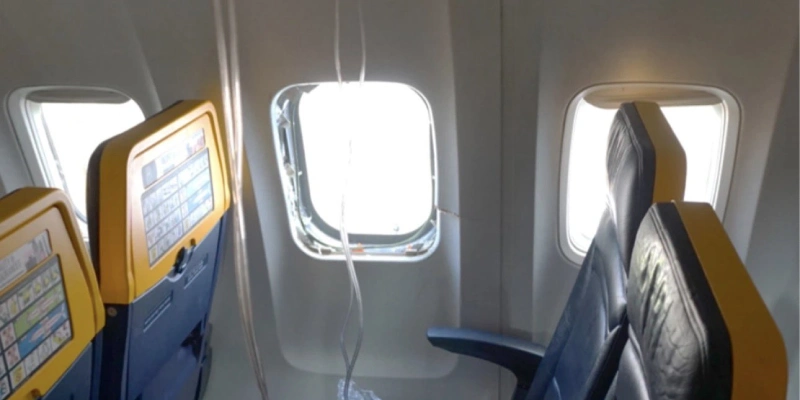
The U.S. National Transportation Safety Board (NTSB) has released its preliminary report on the July 10 incident involving a Ryanair Boeing 737 en route to Germany. The investigation confirmed the recovery of bird remains within the aircraft’s powerplant, which suffered a severe failure shortly after departing from Greece.
During the event, an engine component detached and struck the fuselage, shattering a passenger window. This caused a passenger to be partially drawn outward and sustain injuries, triggering a rapid cabin depressurization and an emergency landing.
According to the NTSB, the flight crew had reported four suspected bird strikes on the aircraft’s No. 2 engine during the 12 months preceding the accident. Maintenance inspections following two of those events confirmed the presence of organic debris, though no structural damage was identified at the time.
Technical Investigation Findings and Cockpit Voice Recorder Analysis
Technical analysis of the Cockpit Voice Recorder (CVR) captured a loud bang approximately nine minutes and twenty seconds after the takeoff roll commenced.
→ Ryanair Hits Record 22.2 Million Passengers in July
A detailed physical inspection of the engine revealed the following conditions:
- Fractured Fan Blades: Clear evidence of fracture on the main fan blades.
- Recovered Fragments: Three loose fan blade fragments were recovered from within the engine structure.
- Prior Inspections: The CFM56 engine—manufactured by CFM International, a joint venture between U.S.-based General Electric and France’s Safran—had undergone inspection in May with no anomalies or negative findings recorded.
Industry Precedents and Official Statements
As the lead independent U.S. government agency investigating civil transportation accidents, the NTSB is evaluating whether this event shares commonalities with previous failures involving the same engine family. A notable precedent occurred in April 2018 aboard a Southwest Airlines flight, where an uncontained engine failure shattered a window, resulting in a passenger fatality after being partially drawn through the opening.
In the report, investigators noted: “The investigative team is aware of previous events involving similar engine models that resulted in damage to engine inlets, cowlings, and fuselage structures. Determining any relevant similarities or details between this accident and prior events remains under investigation.”
Meanwhile, Federal Aviation Administration (FAA) Administrator Bryan Bedford previously stated that initial indications do not suggest the recent Ryanair event directly mirrors the circumstances of the Southwest Airlines accident.
Related Topics

Aeromexico Plans to Launch Flights to Caracas in Q1 2027 and Evaluates Making Santiago Seasonal Route Year-Round
Copa Airlines Ramps Up Americas-Wide Campaign for Margarita Island Ahead of Porlamar Route Launch
LATAM Airlines Strengthens Regional Leadership with Five Honors at the 2026 World Travel Awards

Copa Airlines Restores Operations Following Seismic Activity in Panama and Expands Commercial Flexibility Policies

Plataforma Informativa de Aviación Comercial con 13 años de trayectoria.