Ethiopian Airlines Orders Ten Boeing Freighters: Eight 777-8Fs and Two 777Fs to Boost Global Logistics Network
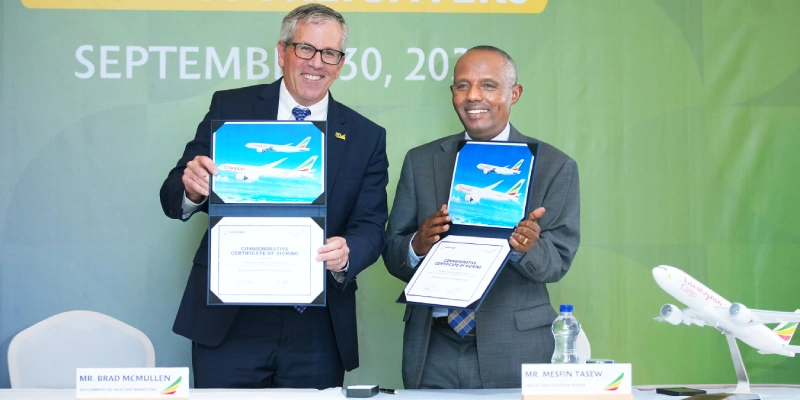




Ethiopian Airlines has signed a firm order with Boeing for eight 777-8 Freighters and two 777 Freighters.
This transaction marks Ethiopian Airlines’ second order for the 777X family, following its earlier commitment for eight 777-9 passenger widebodies—a milestone that originally established the carrier as the first 777X customer on the African continent. By adding the 777-8F, the airline makes history once again as the first in Africa to order the new freighter variant.
With this fleet mix, the carrier aims to combine the proven operational track record of the baseline 777F with the next-generation technological capabilities delivered by the 777-8F.
Technical Specifications and Operational Advantages of the Boeing 777-8 Freighter
Engineered to be the largest and most capable twin-engine freighter in the commercial market, the Boeing 777-8F delivers key operational metrics for Ethiopian Airlines’ cargo division:
- Payload Capacity: Features a maximum structural payload of 118 metric tons, delivering the highest payload capacity and range capability to open new long-haul markets.
- Economic Efficiency: Reduces fuel burn and offers the lowest operating cost per ton among dedicated freighters.
- Fleet Commonality and Standardization: The 777-8F retains critical baseline 777F characteristics that support high utilization and dispatch reliability, including identical cross-sections, standardized main-deck cargo handling systems, and outsize cargo transport capability.
Currently, the in-service 777Fs across Ethiopian Airlines’ fleet boast some of the highest operational utilization rates in the industry.
→ Chinese Firms Lead Shortlist for Ethiopian Airlines’ New Mega-Airport in Addis Ababa
Mesfin Tasew, Group Chief Executive Officer (CEO) of Ethiopian Airlines, addressed the significance of the agreement:
“This agreement marks another significant milestone in strengthening Ethiopian Airlines’ cargo capabilities while supporting the continued expansion of our global network. Incorporating the Boeing 777-8F and 777F freighters will enhance our ability to serve customers worldwide with increased payload capacity, operational flexibility, efficiency, and sustainability. As demand for air cargo services continues to grow, these aircraft will play a vital role in facilitating global trade, bolstering supply chain connectivity, and further cementing Ethiopia’s standing as a leading cargo gateway bridging Africa with international markets. It also underscores our long-term partnership with Boeing.”
On behalf of the airframer, Brad McMullen, Senior Vice President of Commercial Sales and Marketing at Boeing, stated:
“Ethiopian Airlines’ order for the industry-leading 777 Freighter and the new 777-8 Freighter highlights both the strength of our partnership and the growing global demand for air cargo. We deeply appreciate Ethiopian Airlines’ continued trust in Boeing and the 777 and 777X aircraft families as it expands its freight operations and global reach. The airline continues to lead the region, making history as the first carrier in Africa to order the new 777-8 Freighter.”
Current Status and Outlook for Ethiopian Airlines Cargo Fleet
Currently, the Ethiopian Airlines Cargo network serves more than 70 dedicated freight destinations across Africa, Asia, Europe, the Middle East, and North America. Its dedicated operational freighter fleet comprises:
- 12 Boeing 777 Freighters.
- 2 Boeing 767 Freighters.
- 4 Boeing 737-800SF (Special Freighter) converted aircraft.
The addition of these ten new twin-engine widebody freighters will enable Ethiopian Airlines to expand its global operational footprint, delivering greater capacity and flexibility to capture rising demand across international air freight markets.
Related Topics

Satena to Launch Direct Flights Between Montería and Panama City in October

LATAM Airlines Dismisses Rumors Regarding the Creation of a Venezuelan Subsidiary

Avianca Bolsters Argentina Connectivity: Daily Service to Cordoba and Revamped In-Flight Experience
British Airways Expands Network for Summer 2027: Touches Down in Tanzania and Boosts Latin American Capacity by 25%

Un apasionado por la aviación, Fundador y CEO de Aviación al Día.