
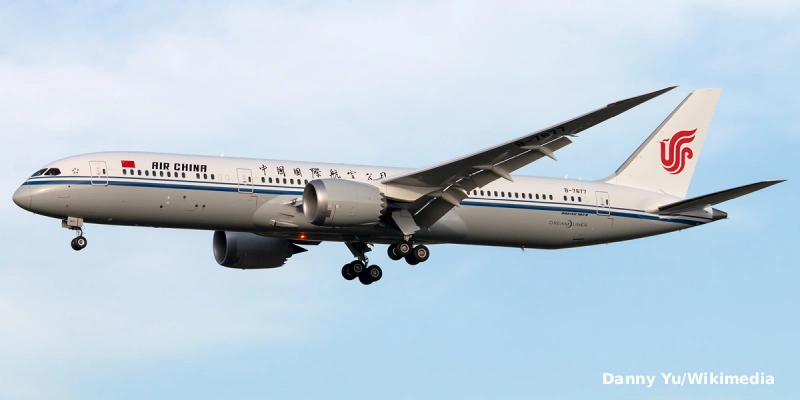
The trade association Airlines for America (A4A), which represents carriers such as American Airlines, Delta Air Lines, and United Airlines, among others, formally stated its rejection on Friday of the request submitted by the state-owned Chinese carrier Air China.
The Asian carrier requested the scheduling of two additional operations for this week and next week on routes connecting Beijing with New York and Washington, coinciding with the schedule of the meeting between Chinese President Xi Jinping and U.S. President Donald Trump.
A4A argues that these operations should not be added to regular commercial schedules:
- Regulatory risk: Including these services in scheduled itineraries could set a precedent for Chinese airlines to request more regular flights in the future.
- Operational reclassification: U.S. carriers maintain that, due to their ad-hoc nature, these extraordinary operations must be processed strictly under the charter flight classification.
Operational Gap: Exclusion of Russian Airspace
The core issue of the conflict lies in the asymmetric operating conditions on intercontinental routes. While U.S. carriers are barred from accessing Russian airspace, Chinese airlines continue to use it on several of their services to and from U.S. territory.
→ Turkish Airlines and Air China Expand Codeshare Agreement
This restriction effectively prevents U.S. air carriers from commercially serving viable routes from the U.S. East Coast to China.
Operational and Economic Advantages for Chinese Carriers
In its formal filing, the group representing North American airlines emphasized that Chinese carriers enjoy “shorter, less costly, and more economical” routes in the market between the two countries. These asymmetries directly translate into:
- Shorter flight times: More direct trajectories by overflying Russian territory.
- Fuel savings: A substantial reduction in fuel consumption, which significantly lowers operating costs.
- Commercial expansion: Chinese airlines have capitalized on this cost and time advantage to gain market share against international operators that must reroute their flights.
Background and Trade Tensions
The closure of Russian airspace to operators from the United States and other foreign nations occurred as retaliation following the ban imposed by Washington on Russian flights in March 2022, in the wake of the invasion of Ukraine. Not being subject to these sanctions, Chinese airlines maintained their usual overflights.
The U.S. airline industry has long criticized this disparity. In October 2025, the U.S. Department of Transportation (DOT) proposed prohibiting Chinese airlines from overflying Russia on their services to and from the United States, arguing that the reduction in flight time harms and places U.S. airlines at a competitive disadvantage.
However, the department’s initiative was shelved prior to a series of trade negotiations with China, after facing opposition from other U.S. government agencies.
Sector Outlook
A4A’s claim reflects the persistent tension between commercial aviation policy and global geopolitics. U.S. airlines insist that, until there is a level playing field in airspace access and the cost structure of transpacific and intercontinental routes, any addition of regular flights by Chinese operators deepens the asymmetry in the bilateral market.
Related Topics

Tocumen Airport and Copa Airlines Resume Operations Following Powerful Earthquake in Panama

Birmingham Airport Plans £2 Billion Investment to Reach 30 Million Passengers in New Master Plan
Missile Strikes Damage Saudia Aircraft at Riyadh Airport, Triggering Mass Flight Cancellations

American Airlines to Build Network’s Largest Admirals Club at Charlotte


Plataforma Informativa de Aviación Comercial con 13 años de trayectoria.