Birmingham Airport Plans £2 Billion Investment to Reach 30 Million Passengers in New Master Plan
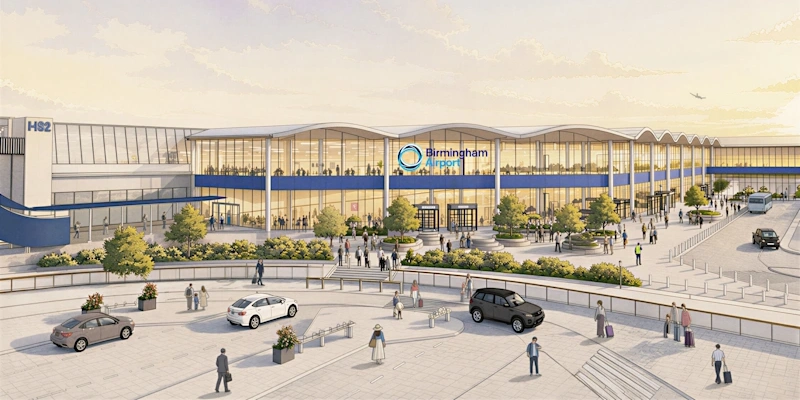




Birmingham Airport (UK) has unveiled its draft Master Plan, a 15-year strategic roadmap outlining an unprecedented £2 billion capital investment program aimed at scaling capacity toward 30 million annual passengers.
The document sets out frameworks to maximize the operational capacity of its existing single runway without the need for additional runways, comprehensively modernize passenger terminal facilities, and enhance surface access transport links—all delivered under a framework of sustainable development and local community engagement.
Strategic Investment Pillars and Development Phases
The expansion proposal anticipates commencing its first phase of construction next year. The capital expenditure program allocates core funding toward operational efficiency and passenger experience:
- Baggage handling and screening: Comprehensive overhaul and expansion of baggage handling systems (BHS) and facilities.
- Apron and aircraft parking: Reconfiguration of airside operational areas and the addition of new aircraft stands.
- Terminal infrastructure: Substantial enhancements across passenger terminal buildings to accommodate projected passenger flows.
- Surface accessibility: Optimization of multi-modal ground transport connections and direct access routes serving the airport site.
→ Istanbul Airport Inaugurates Its Sixth Runway
Socioeconomic Impact and Government Support
According to UK government officials, the delivery of this master plan will serve as a key economic catalyst for the West Midlands.
Transport Secretary Heidi Alexander stated that the scheme will unlock strategic investment and catalyze the creation of 50,000 well-paid local jobs, underscoring central government backing for airport expansion across the nation—a strategy that includes over £219 million committed to sustainable aviation fuel (SAF) development.
For his part, Richard Parker, Mayor of the West Midlands, highlighted that this infrastructure project will bolster local supply chains, elevate the region’s international connectivity, and support regional enterprises through direct community integration.
Fiscal Challenges and Financial Viability
Despite the scale of the development program, airport management has made the full delivery of capital works conditional on a stable macroeconomic and fiscal environment.
Nick Barton, Chief Executive Officer of Birmingham Airport Limited, cautioned that the delivery phase comes amid mounting operational cost pressures driven by payroll, energy, and taxation:
- Tax burden: English airports face ongoing uncertainty surrounding business rate revaluations, an issue that has already doubled the commercial property tax liability at Birmingham Airport.
- Long-term investment cycles: The airport operator underscored to the British Government that long-term aviation infrastructure investments require sustainable shareholder returns; consequently, an adverse fiscal and regulatory climate could restrict capital financing and jeopardize projected economic growth.
Public Consultation Leading to 2027
As part of its stakeholder and community engagement strategy, an eight-week public consultation period has commenced, beginning with an inaugural event at Hampton in Arden on October 16. In total, 20 in-person public sessions will take place, supplemented by digital and postal feedback channels.
Submissions, feedback, and requirements gathered throughout this phase will be reviewed and synthesized into a final report scheduled for publication in 2027. This document will define how community and stakeholder inputs shape the final version of the Master Plan and the airport’s future capital investment commitments.
Related Topics

Avianca Flight from Medellin to New York Diverts to Miami Due to Severe Turbulence; At Least Eight Hospitalized
Southwest Airlines Evaluates Widebody Aircraft, Eyes Boeing 787

Air France to Expand US Network with New Direct Flights to Nashville and San Diego for Summer 2027

Icelandair Adds Madrid and St. Louis to Route Network for Summer 2027, Expands Southwest Partnership

Un apasionado por la aviación, Fundador y CEO de Aviación al Día.