
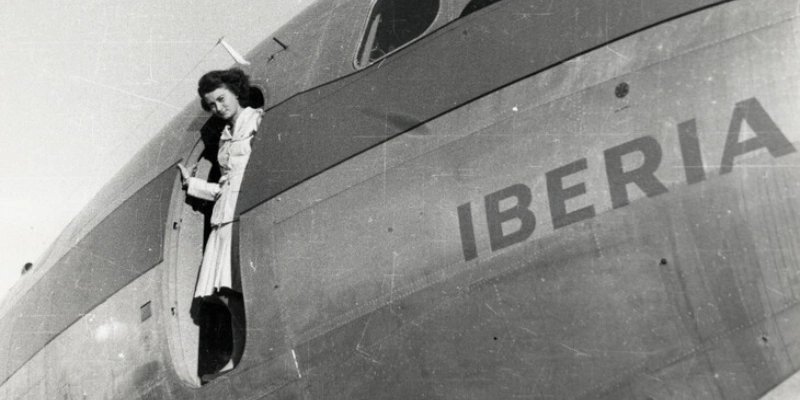
Iberia is celebrating the 80th anniversary of the flight attendant profession in Spain, a milestone that began on its historic first transatlantic service in 1946 and transformed the role into a cornerstone of cabin safety.
The 1946 Inaugural Flight: The Birth of a Profession
The cabin crew profession in Spain was formally established on October 15, 1946, when Iberia operated its first commercial transatlantic flight between Madrid and Buenos Aires. This historic operation was flown aboard a Douglas DC-4, completing the journey in roughly 36 hours following technical stops in Villa Cisneros (Western Sahara), Natal, and Rio de Janeiro.
Twenty-eight passengers were aboard that flight, paying fares of 11,435 pesetas for a one-way ticket and 20,583 pesetas for a round trip.
In the profession’s early days, several titles were considered—such as aeromozas, aeroviarias, mayordomas, or provisorias—before the Spanish term azafata (stewardess) was formally adopted. The inaugural recruitment drive brought onboard four women:
- Pilar Mascías
- Marichín Ruiz
- María José Ugarte
- Ana Marsans
A core requirement for their recruitment was fluency in foreign languages, primarily English. In 1947, Fernando Castillo—formerly a waiter at a luxury Madrid restaurant—joined the airline, becoming Iberia’s first male flight attendant.
→ Iberia Begins Countdown to Its Centenary: Unveils Commemorative Livery and Event Program
During this early era, the role was strictly service-oriented, focusing on reassuring passengers and delivering in-flight catering. On that inaugural service, the onboard meal consisted of fried chicken, Spanish omelette, hard-boiled eggs, and chocolates, all served in small cardboard boxes.
Evolution of the Uniform: Haute Couture Meets Functionality
Spain’s pioneering cabin crew did not wear uniforms on their earliest flights. Shortly thereafter, Iberia introduced corporate attire for its crews: a white two-piece suit crafted from parachute silk for the summer and a navy blue design for the rest of the year, both featuring a distinct military cut. Over time, the service cap was retired, and the white fabric was phased out because it soiled too easily.
Beginning in the 1960s, the Spanish flag carrier integrated haute couture into its crew identity:
- Manuel Pertegaz: Spearheaded the partnership between the airline and Spanish high fashion during the 1960s.
- Elio Berhanyer: Took over uniform design duties in the 1970s.
- Adolfo Domínguez and Alfredo Caral: Carried forward the lineage of Spanish designers across subsequent decades.
- Teresa Helbig: The Catalan designer leading the airline’s uniform styling since 2020, becoming the first woman to design Iberia’s uniforms. Her collection balances elegance, comfort, and functionality in navy blue, red, and yellow tones.
From Hospitality to Operational Safety Guardians
Over the decades, the role has undergone an extensive technical transformation. Today, Iberia’s cabin crew workforce comprises 4,062 professionals:
- 2,735 women (67%)
- 1,327 men (33%)
Today, flight attendants’ primary responsibilities center on cabin safety and contingency management.
“A flight attendant’s role goes far beyond delivering safety demonstrations. Their duties include pre-flight emergency equipment checks, managing passenger evacuations, identifying potential security risks, and responding to in-flight contingencies or onboard medical emergencies—all in close coordination with the flight deck crew and ground handling personnel,” notes Paco Rueda, Head of Cabin Crew at Iberia.
Related Topics
Panama: Tocumen Airport Surpasses 17.8 Million Passengers Between January and September 2026
Emirates and El Dorado Airport Conduct Colombia’s First Travel Rehearsal for Individuals on the Autism Spectrum
Argentine Airports Record All-Time Passenger Traffic High in September

US Lawmakers Demand FAA Halt Use of New AI Tool in Washington Airspace

Plataforma Informativa de Aviación Comercial con 13 años de trayectoria.