Argentina: Ezeiza Airport Reopens Main Runway Following Renovation Works
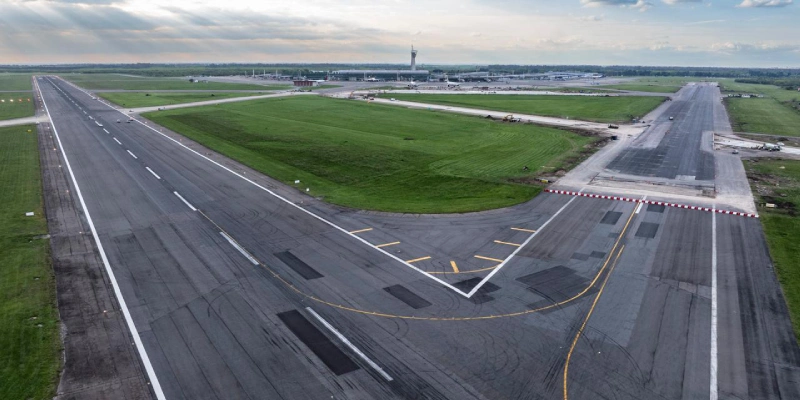




Buenos Aires’ Ezeiza International Airport has fully reopened its main Runway 11-29 after completing rehabilitation works at the intersection of both runways, executed without interrupting flight operations. This reopening marks a major milestone within a comprehensive US$100 million investment plan aimed at modernizing airside and landside infrastructure, cargo terminals, and passenger processing technology.
The full commissioning of Runway 11-29 took effect at 04:00 local time, meeting the technical schedule established by airport operator Aeropuertos Argentina. Operations resumed immediately with the departure of JetSmart flight WJ3211 bound for El Calafate.
Completing the work at the runway intersection now allows engineering teams to focus efforts on the secondary runway:
- Runway 17-35: Remains under a complete overhaul, with completion scheduled toward the end of this year.
- Taxiways: A phased reopening will be implemented to fully restore aircraft ground movement and maneuvering.
- Taxiway Alpha Repaving: Works focused on optimizing taxi flows and operational safety.
New Apron Golf and Operational Support
A standout feature of the airside package is the construction of Apron Golf, an infrastructure project specifically designed for the simultaneous parking and operation of seven narrow-body aircraft, equipped with dedicated ramp space.
→ FAA Deploys First Digital Control Towers in Florida and Alaska to Modernize Air Traffic Management
The operational project also includes:
- Complete refurbishment of the airfield lighting ring.
- New maintenance modules for ground handling operations.
- Renewable power supply systems (GPU) for five aircraft stands.
Landside Transformation: Capacity and Passenger Experience
The program, unveiled in February, encompasses physical expansion and service upgrades tailored to meet growing domestic and international passenger demand.
- Domestic Arrivals: A 1,200 m² expansion of the terminal footprint.
- Pre-boarding Area: Reaches a total area of 3,500 m².
- Boarding Gates: Addition of five new gates, bringing the total to 12 departure positions.
- Ancillary Services: Projected opening of a new VIP lounge, dining options, and a dedicated children’s play area.
These upgrades complement operational improvements executed in 2025, including the overhaul of the security screening checkpoint, the addition of the premium VIPClub lounge, the Sensory Room for individuals on the autism spectrum, and the consolidated rental car facility.
Technological Overhaul and Biometrics
In terms of passenger processing, the plan upgrades the airport’s digital architecture by deploying more than 1,700 peripheral devices:
- Next-generation check-in desks and boarding gates.
- Self-service kiosks and automated bag drop (ABD) units.
- Biometric-compatible passport readers, baggage tag printers, and boarding pass printers.
- Upgraded Flight Information Display Systems (FIDS) and security screening equipment.
Cargo Sector Expansion and Sustainability
Next week, the Aeropuertos Argentina Cargas division will inaugurate the Single Courier Terminal (TUC), a 12,000 m² logistics facility. Concurrently, perishable export infrastructure will expand from 4,500 m² to nearly 7,000 m² equipped with temperature-controlled technology, complemented by a new road access layout connecting to the Riccheri Highway.
On the environmental front, the airport will incorporate a new water treatment plant utilizing reverse osmosis technology, engineered with the capacity to treat 100% of the wastewater generated on-site.
New Terminals and the Federal Infrastructure Plan
Added to the ongoing US$100 million investment is the recently announced National Airport System Expansion Plan, agreed upon with the National Government. This contractual framework allocates **US$1.5 billion over the next five years, jointly financed through direct investment by Aeropuertos Argentina—tied to the concession extension of 35 air terminals—and the Fund for the Strengthening of the National Airport System.
Within this long-term blueprint, which encompasses US$7.5 billion nationwide, Ezeiza plans to construct two new standalone terminal buildings: one for international arrivals and another dedicated exclusively to domestic flights, consolidating the structural capacity of the country’s primary gateway.
Related Topics

United Airlines Restricts Access to Third-Party AI Assistants to Protect Customer Data
Frontier Airlines Opens Bookings for New First Class, Unveils Cabin Overhaul with Extra Legroom and In-Flight Connectivity
United Airlines Opens New Concourse E at Washington Dulles International Airport

Delta Expands Summer 2027 Schedule with New Routes and Increased Frequencies

Plataforma Informativa de Aviación Comercial con 13 años de trayectoria.