American Airlines Under Pressure: Winter Storm that Exposed Limits of Its Operational Recovery System
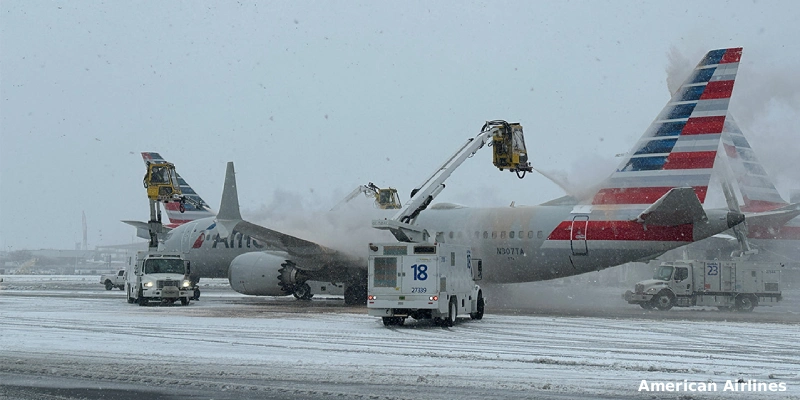




The world’s largest airline by fleet size is facing one of the most complex operational episodes in its recent history. An intense winter storm that swept across the United States last weekend not only triggered thousands of cancellations at American Airlines but also exposed structural tensions in its recovery capacity, particularly regarding crew management, hotel accommodations, and flight schedule reconstruction.
More than 9,000 Cancellations and Significant Financial Impact
According to data confirmed by the company, the weather event resulted in more than 9,000 cancelled flights, making it the largest meteorological disruption in American Airlines’ history. The airline preliminarily estimates that the impact will reduce first-quarter revenue by $150 million to $200 million, in addition to causing a slight reduction in planned flight capacity for the period.
CEO Robert Isom explained that American was more severely affected than its competitors because the storm directly struck the core of its operational network.
- The Dallas–Fort Worth (DFW) area, its primary global hub, suffered persistent icy conditions.
- Nearly one-third of the company’s employees reside there, making it difficult for pilots, cabin crews, and ground staff to reach the airport.
Comparison with Delta and United: A Clear Operational Gap
The magnitude of the impact was reflected in daily figures. By 10:45 a.m. on Wednesday, American had cancelled 459 flights, approximately 15% of its scheduled departures. In contrast, Delta Air Lines cancelled only 12 flights and United Airlines just 10, according to data from FlightAware.
Isom added that the storm simultaneously affected five of American’s nine main operational bases as it moved across the East Coast, a combination that amplified the logistical complexity of the recovery process.
→ American Airlines Redefines Disruption Management: Greater Real-Time Autonomy for Passenger
Stranded Crews and Hotel Shortages: Hours of Waiting in Terminals
Beyond the cancellations, the greatest stress occurred after the storm’s peak. Interviews with union leaders and internal messages from crews reveal long delays in reassigning flights, securing accommodations, and coordinating ground transportation.
- In some instances, crew members were unable to obtain hotel rooms and spent the night in airport terminals.
- Julie Hedrick, president of the Association of Professional Flight Attendants (APFA), stated that some flight attendants waited between six and eleven hours to communicate with departments responsible for reorganizing itineraries and managing hotels.
- “It feels like the worst recovery we’ve ever experienced,” Hedrick told Reuters.
The situation was similar among pilots. Nick Silva, president of the Allied Pilots Association, noted in an internal memo that many pilots were reading his message from terminals, layover hotels, or even while traveling as passengers to reposition themselves for flights. The union anticipated filing formal grievances, including claims regarding the quality of hotels during the disruption.
Company’s Response and Economic Incentives
While American did not respond directly to the union allegations, it shared an internal message from Chief Operating Officer David Seymour. Seymour indicated that teams were repositioning aircraft and clearing gates in Dallas to normalize the flow of operations. The airline also noted that, by mid-afternoon, the airport was already handling more movements than the previous day and extended flight change waivers through Thursday.
“The worst of the impact from this storm is behind us,” Seymour wrote in his internal communication.
To accelerate recovery, American activated a special pay clause to incentivize pilots to take unassigned flights. Internal messages indicate the airline offered the equivalent of five hours and 15 minutes of extra pay on certain days, in addition to regular compensation. One pilot familiar with the program noted it was the first time they recalled this provision being used so broadly, a clear sign of the difficulty in rebuilding operations.
Labor Unrest and Financial Context
The operational crisis coincided with growing frustration among employees. American has lagged behind Delta and United in financial performance, which was reflected in lower profit-sharing payments. Hedrick explained that many flight attendants were particularly upset by the publication of these figures in the midst of a week marked by exhaustion and uncertainty.
Furthermore, Silva stated that many American pilots have experienced a six-figure salary gap compared to colleagues at Delta and United over the last three years, accusing management of repeating excuses without resolving underlying issues.
Related Topics
Eurowings Expands Middle East Network With Nonstop Flights to Baghdad
Emirates Launches Nonstop Flights Between Dubai and Helsinki, Finland

Ryanair Boosts Madrid Operations for Winter 2026: Adds Four New Routes and Reaches 3.4 Million Seats
SWISS Rolls Out Starlink High-Speed Internet: Commercial Debut on an Airbus A320neo

Plataforma Informativa de Aviación Comercial con 13 años de trayectoria.