NTSB: Runway Safety System Failure Preceded Fatal Collision Between Air Canada Express Aircraft and Fire Truck
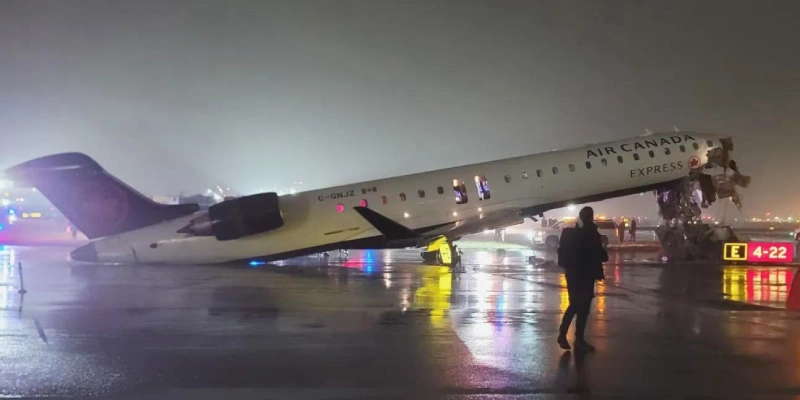




The National Transportation Safety Board (NTSB) revealed in its preliminary report that a critical runway safety system failed to activate prior to the collision between a regional jet and a fire truck. The accident, which occurred on March 22, resulted in the deaths of both pilots and multiple injuries.
Technical Investigation: The Role of Warning Lights
According to NTSB findings, the red Runway Entrance Lights (RELs)—designed to indicate when it is unsafe to cross—remained illuminated until approximately three seconds before impact.
The system’s design stipulates that these lights should extinguish 2 to 3 seconds before an aircraft reaches each intersection. However, in this event, the airport’s surface surveillance system failed to generate any alerts warning of the vehicles’ proximity to the active runway.
Impact Details
The aircraft involved, a Bombardier CRJ-900 operated by Jazz Aviation (an Air Canada Express regional partner), was in the final stages of its landing roll:
- Speed at time of impact: 104 mph.
- Timeline: The aircraft touched down just 2 seconds prior to the collision.
- Casualties: The accident resulted in 39 hospitalizations, six of which involved critical injuries.
→ Airport Infrastructure Cost-Cutting Behind Jeju Air Tragedy in South Korea
Cockpit Communications and Situational Awareness
The NTSB report highlights a critical confusion in radio communications. The fire truck operator recalled hearing the instruction “stop, stop, stop” on the tower frequency but initially did not know to whom it was directed.
Only when he specifically heard “Truck 1, stop, stop, stop,” did the vehicle crew realize the warning was intended for them and noticed they had already entered the active runway.
Equipment Factors and Traffic Control
A key element identified in the investigation is the lack of localization technology on the surface vehicle:
- Absence of Transponder: The fire truck was not equipped with a transponder, a device that would have transmitted its exact position to Air Traffic Control (ATC).
- FAA Recommendations: The Federal Aviation Administration has urged airports to equip emergency vehicles with these devices to facilitate tracking at high-traffic airfields.
- Personnel Involved: The local controller in charge of the Air Canada flight had 18 years of experience, while the ground controller (who was also acting as the controller-in-charge) had 19 years of experience.
Next Steps in the Investigation
The NTSB continues to lead the inquiry to determine why the automated alert systems did not function as intended and how the lack of visibility regarding surface vehicle systems contributed to this fatal outcome. The industry expects the final results to drive new regulations regarding the mandatory use of transponders in airport ground support vehicles.
Related Topics

Lufthansa Group Boosts Connectivity to Japan, Reaching Up to 50 Weekly Flights in Summer 2027

British Airways Launches Multi-Million-Pound Heathrow Airport Lounge Transformation

airBaltic Prepares to Lay Off Up to 700 Employees as Part of Chapter 11 Restructuring

Eurowings Expands Middle East Network With Nonstop Flights to Baghdad

Plataforma Informativa de Aviación Comercial con 13 años de trayectoria.