Airbus Conducts Cargo System and Main Deck Door Tests for New A350F
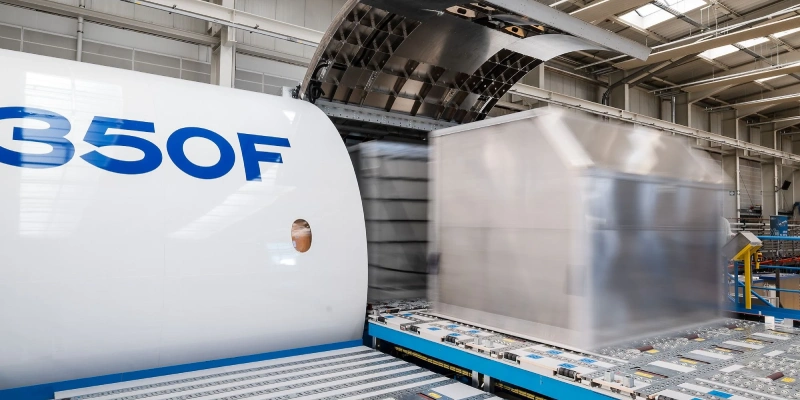




The aircraft manufacturer Airbus is conducting a series of rigorous tests in Bremen, Germany, to validate the Main Deck Cargo Door (MDCD) and the Cargo Handling System (CHS) of the new A350F. These evaluations on physical simulation platforms are fundamental to guaranteeing the aircraft’s safety, optimizing turnaround times, and ensuring certification ahead of its upcoming first flight.
Operational Heart of the A350F: CDAS SIB and Cargo Zero
Developing a next-generation freighter implies much more than simply removing passenger seats from a conventional cabin. The true operational value of a freighter lies in its capacity to efficiently transport, secure, and protect up to 111 tonnes of payload.
To turn digital designs into a certified reality, Airbus engineers in Bremen are utilizing two primary test rigs: the Cargo Door Actuation System System Integration Bench (CDAS SIB) and the Cargo Zero test bed. Both facilities aim to ensure industrial maturity and the aircraft’s operational reliability while de-risking the program before the flight test campaign begins later this year.
CDAS SIB: Validating the Industry’s Largest Cargo Door
The A350 family was conceived from its inception under the “more-electric” aircraft concept. Following this philosophy, the opening and closing mechanism of the new Main Deck Cargo Door was designed to be electrically powered instead of using conventional hydraulic systems.
→ Pratt & Whitney GTF Advantage Earns EASA Certification for Airbus A320neo Family
Advantages of the Electric Door System:
- Space and Weight Optimization: By eliminating hydraulic fluid lines, system complexity is reduced and available space is maximized.
- High-Efficiency Actuators: It utilizes Geared Rotary Actuators capable of fully opening or closing the door in 60 seconds, operating safely even in winds of up to 40 knots.
- Patented Locking Mechanism: It incorporates a completely new latching system based on an Airbus patent that significantly reduces the part count, lowering weight and maintenance costs.
The test demonstrator features a support structure weighing nearly 20 tonnes, equipped with a metal test door that accurately simulates the stiffness, weight, and center of gravity of the final production door, which will be manufactured from carbon fiber composite. Through this rig, the team subjects the sensors, motors, software, and actuators to repetitive simulated structural loads to validate their endurance.
Cargo Zero: Loading Trials in Real-World Scenarios
The Cargo Zero demonstrator represents the step prior to the construction of the first actual flight-test aircraft, designated MSN700. This platform consists of a 24-meter-long, full-scale partial replica that simulates the interior of the A350F’s cargo hold.
The installation features a cross-section of the main door, the hold lining, and a fully functional Cargo Handling System including control panels and Power Drive Units (PDUs).
Extreme Simulation Capabilities of Cargo Zero:
- Flexing and Tilting: The rig can simulate extreme floor flexing conditions and variations in aircraft attitude (nose-up or nose-down pitch) to verify that cargo can slide without hindrance.
- High-Density Loads: It allows for testing the movement of the heaviest Unit Load Devices (ULDs), weighing up to 28 tonnes, as well as delicate high-tech components.
- Turbofan Engine Maneuvers: At the request of customers, specific loading and unloading tests are performed using a full-scale wooden mock-up of a large turbine engine mounted on its dedicated stand, ensuring the floor loading process is automatic and fluid.
- Medical Rescue Drills: Accessibility tests have been completed to determine how ramp personnel or crew could evacuate a person suffering a medical emergency on a stretcher, transferring them safely from the cargo zone to the courier area located behind the flight deck.
Safety Innovation: Tail Tip-Over Warning System
The Cargo Zero platform is also being used to validate the Tail Tip-Over Warning System (TTWS). This safety technology prevents the aircraft from accidentally tipping backward during ground loading processes.
The system is designed to provide alerts in “abusive loading” scenarios—when too much weight is stowed in the aft section of the aircraft while the forward section remains too light—and under adverse weather conditions, such as strong head-on winds or severe snow accumulation on the horizontal tail stabilizer.
Next Steps Toward EASA Certification
Official testing on the Cargo Zero rig began in mid-March after successfully completing the first power-on trials. As explained by Jürgen Ruckes, Airbus Head of Cargo and Door Testing, the initial focus of the Main Deck Cargo Door evaluations is centered on ensuring the system remains unfailingly locked during flight to obtain authorization for the first takeoff.
Subsequently, all data collected in Bremen will be integrated into the European Union Aviation Safety Agency (EASA) certification campaign. Maturity testing and system failure simulations will continue throughout the remainder of this year and extend into 2027. Once the initial development phase is concluded, Airbus plans to open slots on these demonstrators so that end customers can perform specialized training and simulate their own real-world operational scenarios.
Related Topics

Boeing Pays $3.1 Million FAA Fine over Multiple Safety Violations

FAA Mandates Inspections for Select Boeing 787s Over Potential Structural Defects

Boeing Delivers 53 Jets in July, Down 11 From June

FAA Orders Inspection of Hundreds of Boeing 737 MAX Aircraft Over Potential Fuselage Cracking

Plataforma Informativa de Aviación Comercial con 13 años de trayectoria.