Crisis That Led to IndiGo’s Collapse and Exposed the Limits of Its Operating Model
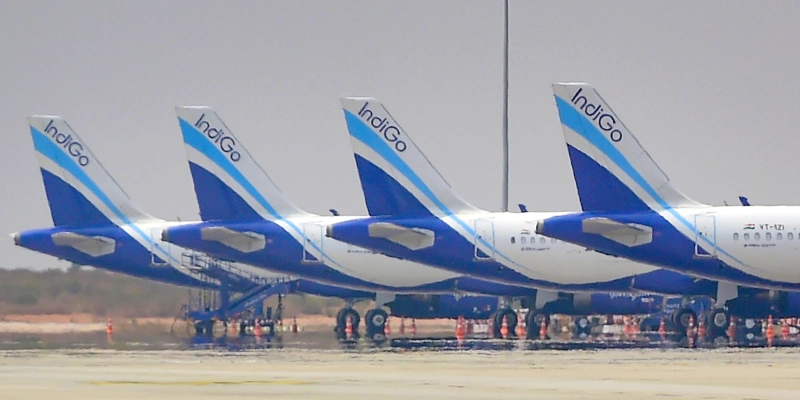




On the afternoon of December 2nd, IndiGo detected a technological failure that delayed overnight check-ins. What seemed like a minor setback ended up exposing an operating system functioning at its limit. The fault affected the pilot shift allocation system, which had recently been adjusted to comply with new government rules requiring more rest hours and fewer nighttime landings.
This change coincided with modifications to winter schedules, air traffic congestion, and bad weather. The balance of India’s largest airline began to unravel.
An Ultra-Efficient Model with No Room for Maneuver
IndiGo grew with a strategy based on optimizing every process. It achieved profitability just three years after its founding and captured 66% of the domestic market. Its operation was based on a single aircraft type—the Airbus A320 family—to reduce costs for training, maintenance, and spare parts. It also implemented methods to shorten ground times: zoned boarding, deplaning using all doors, and even a faster system for weighing sandwiches, its best-selling onboard product.
This discipline allowed it to reduce aircraft turnaround time to between 20 and 25 minutes, compared to the industry standard of 45 minutes. But the structure was designed for a fleet of between 100 and 200 aircraft, less than half of its current size.
According to Shakti Lumba, who headed operations at the start of IndiGo in 2006, the airline needed to revise its processes to build in redundancies, especially in crew planning. The past week made clear why.
→ IndiGo Reports Larger-Than-Expected Losses in Last Quarter
Cascade of Cancellations
Scheduling began to fail and the impact multiplied: a crew assigned to one flight ended up taking off on another service, leaving a second aircraft without staff. A pilot was stranded for several days in a Middle Eastern hotel awaiting his return assignment. On the ground, employees tried to contain furious passengers while luggage piled up on grounded planes.
The numbers showed the scale of the collapse. IndiGo canceled at least 70 flights on December 3rd, 300 on the 4th, and more than 1,000 on the 5th—nearly half of its daily operations.
The government reacted immediately. It suspended the new pilot rest rules, imposed fare caps to prevent price gouging, and deployed additional state-run trains to move affected passengers. It also ordered CEO Pieter Elbers to explain within 24 hours why the airline should not face penalties for failures in planning and oversight.
A Blow to Reputation and the Market
The chaos caused shares of InterGlobe Aviation Ltd., IndiGo’s parent company, to fall by as much as 7.6% on Monday and extend losses for seven consecutive days. In total, the company lost about $4.3 billion in market value. The previous week, the stock had retreated 9%, its worst performance since Elbers took over in 2022.
Nevertheless, the shares have nearly tripled since the executive assumed his role, significantly outperforming the Sensex index, which rose 49%, and an index of Asian airlines, which gained 8.4%.
The episode comes six months after an Air India accident that left more than 260 dead in Ahmedabad, capping one of the most difficult years for the country’s aviation sector. For analysts like Mark D. Martin, founder of Martin Consulting, the airline has suffered serious damage to its credibility.
A Market Leader Under Pressure
The incident also calls into question IndiGo’s weight in India’s air system. With two-thirds of the domestic market, any internal problem can paralyze a large portion of national traffic. In the United States and China, the other two largest markets, no airline holds a share exceeding 25%.
For analyst Ajay Bodke, what happened reflects more than a simple error: almost two years after the new pilot rules were announced, asking now for a two-month postponement demonstrates a lack of compliance that goes beyond inefficiency.
Heading Towards a Forced Recovery
The airline states it will be fully recovered by December 10th. On Saturday it had already reduced cancellations to about 850, and on Sunday it assured that operations would stabilize by the following Wednesday.
However, the episode could force deep changes in the industry, from increased government oversight to a review of IndiGo’s operating model. It also casts a shadow over the company’s international expansion plans, which include more Airbus orders, new business-class seats, and codeshare agreements with Delta Air Lines, Air France-KLM, and Virgin Atlantic.
What began as a minor technical failure ended up revealing a saturated system. And for an airline that made efficiency its hallmark, the challenge now will be to rebuild the trust of a country it serves daily.
With information from Bloomberg
Related Topics
LATAM Airlines Strengthens Regional Leadership with Five Honors at the 2026 World Travel Awards

Copa Airlines Restores Operations Following Seismic Activity in Panama and Expands Commercial Flexibility Policies

Arajet Resumes Direct Flights Between Punta Cana and Guayaquil

LATAM Airlines Announces Nonstop Flights Between Santiago de Chile and Caracas Starting in January
Plataforma Informativa de Aviación Comercial con 13 años de trayectoria.