
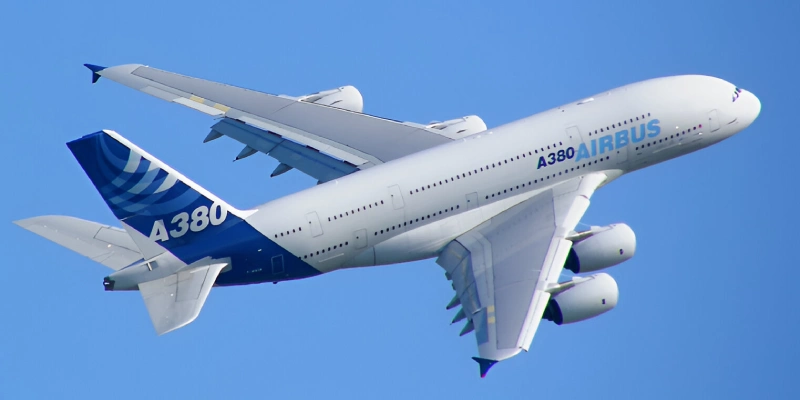
Airbus has achieved something that, until recently, seemed more like a lab concept than an industrial reality: recycling and reusing a structural component made of composite material from a retired A380 and returning it to service on an A320neo. This is not just an isolated technical advance, but a concrete demonstration of how the circular economy can begin to be integrated into commercial aviation, a sector historically complex regarding the recycling of advanced materials.
The project, developed by a consortium led by Airbus alongside Toray Advanced Composites, Daher, and TARMAC Aerosave, has been recognized with a JEC Composites Innovation Award, one of the most prestigious accolades in the composites industry.
From A380 to A320neo: How an Aeronautical Part Was Recycled In-Flight
The component in question is an engine pylon cowl from the Airbus A380, a part considered secondary structure in aeronautical jargon. Upon reaching the end of its service life, this part was recovered and transformed into a smaller-sized panel compatible with the A320neo’s pylon, following re-certification.

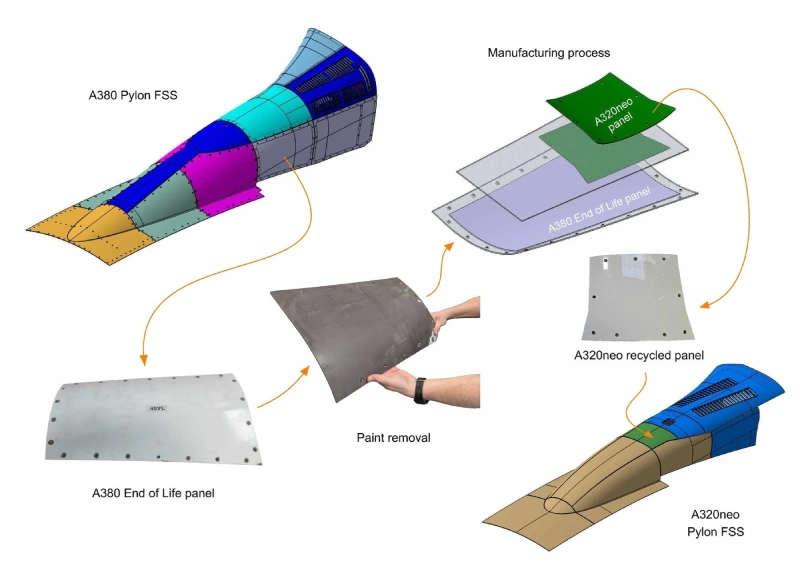
The key to success lies in the use of thermoplastic composites, unlike traditional thermosetting composites, which are notoriously difficult to recycle. According to Airbus, the quality and mechanical properties of the new recycled panel are such that it is indistinguishable from a new part, opening the door to scalable applications in both production lines and retrofits.
This milestone is especially relevant in a context where manufacturers are increasing the use of composite materials to reduce weight and fuel consumption, but face the challenge of managing these materials at the end of their life cycle.
→ Airbus Confirms Delivery of 793 Commercial Aircraft in 2025
An Industrial Collaboration-Based Circular Economy Project
The program demonstrates that circularity in aviation cannot be addressed in isolation. Each consortium partner contributed a critical capability:
Toray Advanced Composites
The supplier and manufacturer of the Toray Cetex® thermoplastic material, originally used in the A380. Beyond developing the material, it characterized its properties and provided key technical support for reprocessing and forming. For its central role, Toray was the formal winner of the JEC Innovation Award in the circularity and recycling category.
TARMAC Aerosave
A specialist in storage, maintenance, and recycling of aircraft at the end of their life cycle, it supplied the out-of-service A380 components that gave rise to the project, preventing high-value assets from becoming waste.
Daher
Responsible for manufacturing the new A320neo components from the recovered material and for industrializing the process, an essential step for making the solution viable at scale.
Airbus
As the OEM, Airbus not only scientifically demonstrated the feasibility of thermoplastic reprocessing but also integrated the solution into a flight-test A320neo, paving the way for future commercial introduction.
International Recognition and a Clear Signal to the Market
The JEC Composites Innovation Awards, presented each January, receive over 170 annual submissions from multiple industries. The award obtained by this project underscores its disruptive nature beyond the aeronautical field.
During the January 2026 ceremony, Isabell Gradert, Vice President of Core Research and Technology at Airbus, highlighted that complex challenges, such as high-value recycling, “are best solved through partnerships,” emphasizing that an industry-wide solution has far greater transformative potential.
It is worth noting that Airbus had already been part of a winning consortium in this same category in 2025, and that in this edition, two other projects led by the European manufacturer were also awarded, one of them again linked to thermoplastics.
Strategic Impact: Less Waste, Less Energy, More Efficiency
Recycling aircraft components is not just an environmental issue. According to Airbus, reusing composite materials consumes less energy than manufacturing new parts, reduces dependence on virgin raw materials, and can support more localized supply chains, an increasingly relevant factor for OEMs and airlines.
The data obtained from this program will feed into Airbus’s eco-design strategy, whose goal is for future components to be conceived from the outset to maximize their recovery and reuse at the end of their service life.
A380: An Unexpected Laboratory for Circularity
A fact illustrating the scale of the challenge and opportunity: the Airbus A380 incorporates more than 10,000 flight-worthy parts manufactured with different variants of carbon-fiber reinforced thermoplastic composites. This figure makes the superjumbo, now in progressive retirement, an ideal platform for validating advanced material recycling practices.
Related Topics
Japan Airlines Selects Embraer E190-E2 to Renew J-AIR Regional Fleet
LATAM Airlines Brazil Takes Delivery of Its First Embraer E195-E2
Embraer Reports Record Third-Quarter Performance With 66 Aircraft Delivered
Embraer Nears Key Regional Jet Order from Japan Airlines


Un apasionado por la aviación, Fundador y CEO de Aviación al Día.