
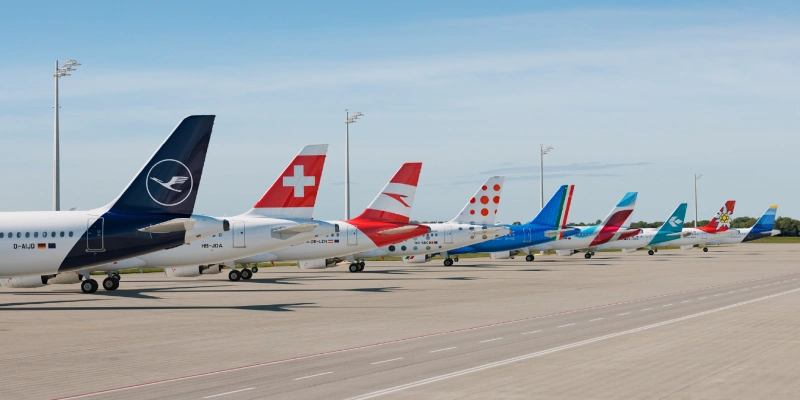
Lufthansa Group closed the 2025 fiscal year by reaching a financial milestone, reporting the highest revenue in its history. This performance was driven by resilient market demand and significant progress within its ongoing transformation program. With an operating profit of €2 billion, the German flag carrier is pivoting toward a 2026 strategy centered on fleet modernization and international expansion, despite persisting geopolitical volatility in the Middle East.
Financial Results: A Year of Historic Milestones
Throughout 2025, the Group consolidated its financial recovery through efficient capacity management and an increased passenger willingness to pay for ancillary services.
- Record Revenue: Turnover increased by 5%, reaching €39.6 billion.
- Operating Profit: Adjusted EBIT (Earnings Before Interest and Taxes) grew by 20% to €2 billion.
- Operating Margin: Group margins improved to 4.9%, up from 4.4% in the previous fiscal year.
- Shareholder Returns: A dividend increase to €0.33 per share has been proposed, representing a 10% year-over-year increase.
Despite this solid operational performance, the consolidated net profit remained at €1.300 billion, impacted by accounting valuation effects related to deferred tax assets and loss carryforwards.
→ Lufthansa Strengthens Southeast Asian Presence with Direct Flights to Kuala Lumpur
Passenger Operations: Record Load Factors and New Product Launches
The Passenger Airlines segment—comprising Lufthansa Airlines, SWISS, Austrian Airlines, Brussels Airlines, Eurowings, and ITA Airways—carried a total of 135 million passengers.
- Passenger Load Factor (PLF): Reached a record high of 83.2%.
- Ancillary Revenue: Grew by 15%, bolstered by the market reception of the premium Lufthansa Allegris product.
- Cost Efficiency: Operational stabilization led to a €362 million reduction in flight irregularity expenses.
- ITA Airways Contribution: The Italian carrier contributed a positive €90 million to the Group’s bottom line.
Progress in the Lufthansa Airlines “Turnaround” Program
The Group’s flagship brand, Lufthansa Airlines, has shown the first signs of recovery under its dedicated transformation initiative. The carrier achieved a positive Adjusted EBIT, improving its annual result by €250 million compared to the previous year.
The program’s objectives remain ambitious: generating a gross earnings effect of €1.5 billion by 2026, scaling to €2.5 billion by 2028. Strategic pillars include:
- Fleet Modernization: Integrating more efficient aircraft, such as the Boeing 787 Dreamliner.
- Strategic Growth: Expanding the operations of Lufthansa City Airlines and Discover Airlines.
Logistics and Maintenance: Pillars of Stability
The Group’s service divisions continued to provide critical strategic and financial value:
- Lufthansa Cargo: Increased its operating profit by 30% to €324 million, supported by stable demand, particularly within the Asian market.
- Lufthansa Technik: Despite the impact of tariffs and US Dollar exchange rate fluctuations, the division generated a profit of €603 million.
- MRO Services: The Maintenance, Repair, and Overhaul unit secured new contracts with a total value of €8.8 billion.
2026 Outlook: Fleet Updates and Geopolitical Challenges
For the current year, the Group expects its fleet modernization to reach its peak, with an average delivery rate of nearly one new aircraft per week. By the end of 2026, next-generation aircraft are projected to account for 30% of the total fleet.
However, Carsten Spohr, CEO of Deutsche Lufthansa AG, warned of the industry’s vulnerability to the conflict in the Middle East. Volatility in oil markets and potential supply chain disruptions in the Strait of Hormuz remain latent risks to financial forecasts.
Despite these headwinds, the company remains optimistic due to surging demand on long-haul routes to Asia and Africa. This trend has prompted the Group to evaluate additional frequencies to hubs such as Singapore, India, China, and South Africa.
“We will continue to expand our position as the leading airline group outside of the U.S.,” Spohr stated.
Related Topics
LATAM Airlines Strengthens Regional Leadership with Five Honors at the 2026 World Travel Awards

Copa Airlines Restores Operations Following Seismic Activity in Panama and Expands Commercial Flexibility Policies

Arajet Resumes Direct Flights Between Punta Cana and Guayaquil

LATAM Airlines Announces Nonstop Flights Between Santiago de Chile and Caracas Starting in January


Un apasionado por la aviación, Fundador y CEO de Aviación al Día.