Global Ranking of World’s Busiest Airports in 2025: Atlanta Maintains Lead




Airports Council International (ACI) World has released its operational results for 2025, highlighting a robust recovery in international traffic and a significant surge among hubs in the Asia-Pacific region. With a global volume of 9.8 billion passengers, the aviation industry is demonstrating its resilience in the face of a complex macroeconomic environment and increasing capacity constraints.
Atlanta’s Dominance and the Rise of Asian Hubs
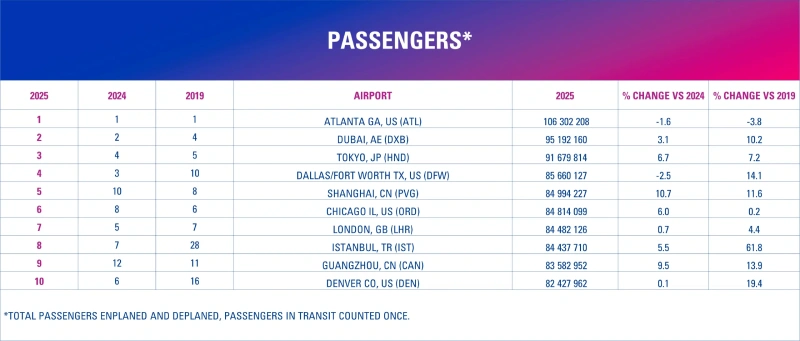
Hartsfield-Jackson Atlanta International Airport remains firmly established as the world’s busiest airport in terms of total passenger traffic, recording 106.3 million travelers. It is followed by Dubai International Airport with 95.2 million, and Tokyo Haneda Airport, which climbed to third place with 91.7 million passengers.
The ACI World report underscores a key trend: the resurgence of Asia-Pacific airports. Among the most significant shifts are:
- Shanghai Pudong: Recorded the largest jump within the “Top 10,” moving from tenth to fifth position. This growth is attributed to the recovery of international traffic, the easing of visa policies, and enhanced connectivity.
- Guangzhou Baiyun: Returned to the ninth spot—a meteoric rise considering it was ranked 57th in 2022.
- U.S. Strength: Four of the ten busiest airports are located in the United States, characterized by a high share of domestic traffic ranging between 80% and 95%.
International Traffic and Air Cargo: Engines of Growth
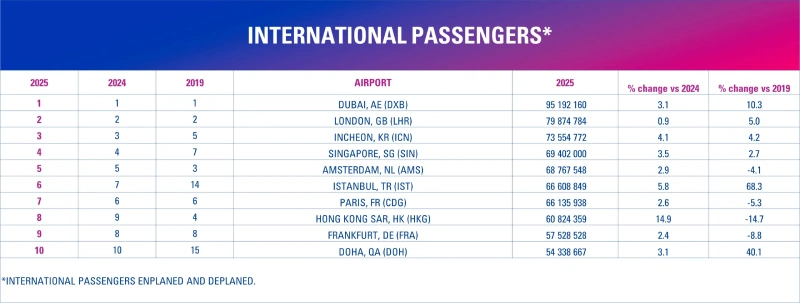
In the international passenger segment, global volume reached 4 billion in 2025, representing a 5.9% increase over 2024 and surpassing 2019 levels by 8.3%. In this category, Dubai maintains the top spot, followed by London Heathrow and Seoul Incheon.
On the other hand, air cargo experienced a 2.9% year-on-year increase, reaching 128.9 million metric tonnes. This sector shows high concentration: the top 10 cargo airports handle nearly 26% of global volume. The undisputed leaders are:
- Hong Kong
- Shanghai Pudong
- Anchorage, which ranks third.
This growth in cargo has been primarily driven by sustained demand from e-commerce and the realignment of global supply chains.
Operations and Aircraft Movements
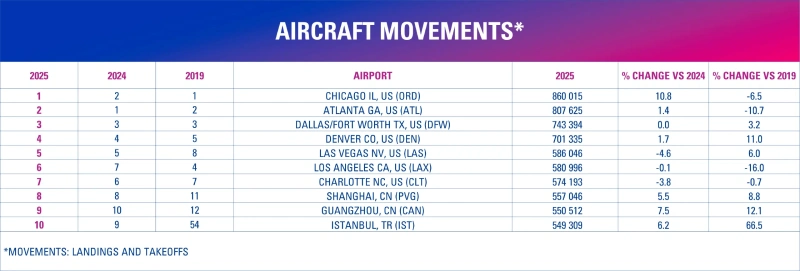
In terms of operational efficiency measured by aircraft movements, it is estimated that 101.5 million operations were carried out worldwide in 2025. Chicago O’Hare International Airport leads this ranking, followed closely by Atlanta and Dallas/Fort Worth. The top ten airports in this category represent 6.4% of global movements.
Macroeconomic Context and Industry Challenges
Despite the positive results, the sector operates in a fragile equilibrium. Global Gross Domestic Product (GDP) grew between 3.0% and 3.2% in 2025, a figure higher than expected but lower than historical norms.
Among the factors that shaped the year are:
- Operating Costs: Jet fuel prices fell approximately 13% year-on-year, which, combined with moderate inflation, supported passenger demand.
- Capacity Constraints: Growth is threatened by a lack of infrastructure, slot restrictions, aircraft delivery delays, and air navigation limitations.
- Geopolitics: Airspace closures and international conflicts have increased flight times and costs, forcing airlines to seek alternative routes.
ACI World Director General Justin Erbacci highlighted the importance of these hubs for regional economic growth and warned that, to maintain this momentum, “governments must prioritize sustained investment in airports and the broader aviation ecosystem.”
Related Topics
End of an Era: Lufthansa Retires Airbus A340-600 Fleet After 23 Years of Service
Aviation Capital Group Signs Firm Order for 75 Airbus A320neo Family Aircraft
Airbus Plans to Accelerate A350 Production Ramp-Up and Evaluates Higher-Capacity Variants

Global Aviation Services Market to Double, Surpassing $420 Billion by 2045, Says Airbus

Un apasionado por la aviación, Fundador y CEO de Aviación al Día.