
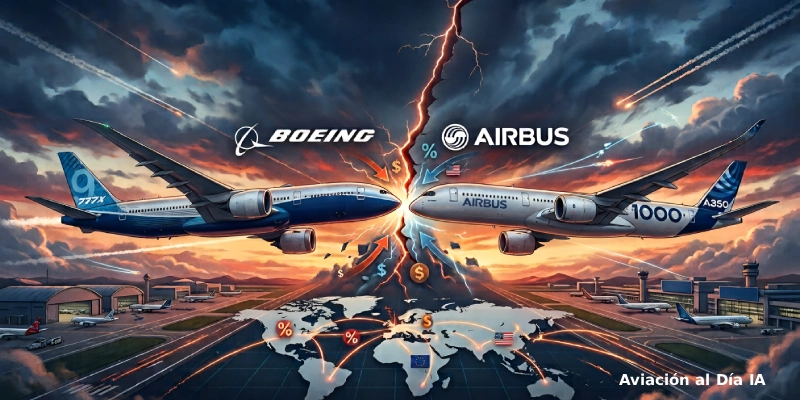
The aerospace industry’s geostrategic landscape is experiencing renewed friction following Boeing’s formal request for the U.S. government to step in regarding the European Union. According to an exclusive report by Reuters, the American planemaker is demanding answers and transparency over a €3 billion loan granted to its commercial rival, Airbus, by the European Investment Bank (EIB).
This action reactivates the longstanding trade disputes between the two commercial aviation giants, coming shortly after both sides agreed to an indefinite extension of the truce on subsidies and tariffs that was set to expire on July 6.
The Trigger: The EIB’s Largest Corporate Financing Deal
According to a letter sent to U.S. Trade Representative (USTR) Jamieson Greer, Boeing expressed surprise at the announcement made by the EIB—the financial arm of the European Union—on June 29. The financial commitment marks the largest corporate loan in the bank’s history in favor of Airbus and includes an initial tranche of €1 billion.
Boeing highlighted the unusual timing of the deal, noting that the EIB’s announcement came just four days after the European Union decided to extend the tariff suspension agreement originally brokered in 2021. In the letter, Boeing asked the USTR to request a “full accounting of the terms of this loan” and to assess whether the measure aligns with the principles of an “open and transparent process” established under the 2021 truce.
For their part, EIB spokespeople denied that the operation constitutes favorable treatment or illegal state aid. The institution noted that it finances thousands of companies annually, clarifying that it is “a standard interest-bearing loan framed within the EIB’s routine financial operations.”
Project “eAction”: A320neo Successor in the Crosshairs
The core of Boeing’s concern goes beyond the financial numbers and directly impacts the technological development of commercial aviation. The EIB financing package is designated to support Airbus’s long-term investments through 2030.
→ Boeing Projects Global Commercial Fleet Will Exceed 50,000 Aircraft in 20 Years
This timeline aligns directly with the schedule outlined by Airbus Chief Executive Guillaume Faury for the launch and development of the replacement for the best-selling Airbus A320neo. In statements prior to the Farnborough Airshow published by Aviation Week, Faury confirmed plans for a new aircraft by around 2030 and revealed the project’s internal codename: “eAction.”
In its letter, Boeing emphasized that the overlap between the loan’s size and Airbus management’s announcements regarding a new aircraft program raises serious questions about the true scope and intent of the financial aid package.
Conflicting Stances on the Next-Generation Aircraft
- Airbus: Envisages launching the development of a new single-aisle platform by 2030 under the internal project “eAction.”
- Boeing: Maintains that current market conditions are not yet suitable for launching a next-generation commercial aircraft, though industry analysts anticipate both manufacturers will initiate projects toward the middle of the decade.
Regulatory Context and the WTO Framework
The rivalry between Boeing and Airbus carries a 17-year history of litigation before the World Trade Organization (WTO), where both parties secured partial rulings over mutual claims of illegal subsidies, leading to cross-transatlantic tariffs.
Although President Trump’s administration agreed to exempt aircraft and components from tariffs—and Washington has not formally finalized the truce extension agreement—sources close to the industry indicate both sides had considered the WTO dispute temporarily shelved. Meanwhile, European sources maintain that similar loan schemes were previously validated within the framework of the WTO litigation.
Boeing’s request opens the possibility that this EIB loan package could be brought into trade negotiations convened by the U.S. administration to address the impact of foreign aircraft imports. The coming months will be decisive in determining whether the truce between the two aerospace giants holds, or if the sector enters a new chapter of trade conflict.
Related Topics
Sydney Opens Second Airport Amid Sluggish Initial Flight Volumes

Panama: Tocumen Airport Surpasses 17.8 Million Passengers Between January and September 2026

Emirates and El Dorado Airport Conduct Colombia’s First Travel Rehearsal for Individuals on the Autism Spectrum
Argentine Airports Record All-Time Passenger Traffic High in September

Plataforma Informativa de Aviación Comercial con 13 años de trayectoria.