Russia Extends Superjet 100 Service Life to 20 Years
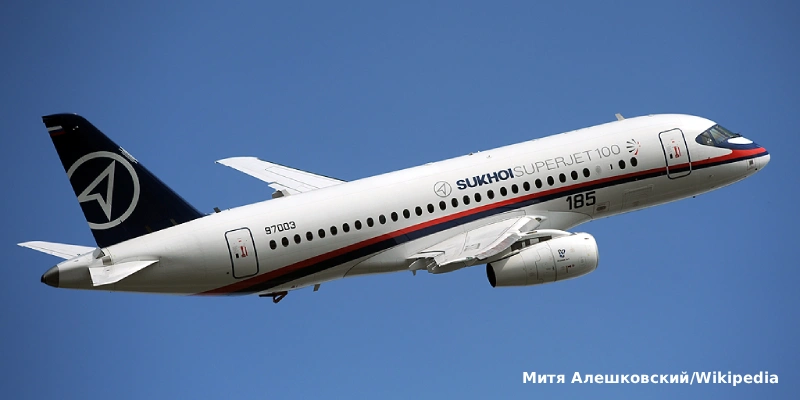




Russia’s Federal Air Transport Agency (Rosaviatsia) has approved a five-year extension to the certified operational life of the Superjet 100. The technical ruling allows 154 strategically critical aircraft to remain in service while the domestic aerospace industry works toward certifying a locally sourced replacement model and resolves the costs associated with re-engining the fleet.
Extended Operating Limits: Flight Hours, Flight Cycles, and Calendar Years
The operational life of a commercial aircraft is governed by three concurrent parameters: accumulated calendar years, flight hours, and flight cycles (where each takeoff and landing constitutes one cycle). Upon reaching any of these limits, the airframe must undergo re-evaluation to maintain its airworthiness status.
On Monday, Rosaviatsia formalized a major change to the type design of the Russian regional twinjet, raising all three operational thresholds:
- Calendar Service Life: Increased from 15 to 20 years.
- Flight Hours: Extended from 25,000 to 40,000 flight hours.
- Flight Cycles: Increased from 15,000 to 20,000 flight cycles.
This approval covers both the baseline RRJ-95B-100 variant and the extended-range RRJ-95LR-100, both powered by SaM146 engines.
According to Rosaviatsia, the new certification approval is backed by analytical modeling, full-scale structural fatigue testing, and operational data accumulated across the commercial fleet in revenue service. Vladimir Lavrov, chief designer of the program, told Vedomosti that the revised parameters validate the airframe’s structural integrity, while manufacturer Yakovlev, a subsidiary of the United Aircraft Corporation (UAC), is working to secure further increases to these margins in the future.
SaM146 Engine Support Challenge
The Superjet was originally designed as an internationally integrated program. Its SaM146 turbofan engines were developed by PowerJet, a joint venture between France’s Safran and Russia’s NPO Saturn, with additional participation from Italy’s Alenia Aeronautica.
Following the rollout of serial production in 2011 and the subsequent imposition of Western sanctions in 2022, the supply chain and official OEM technical support from the French partner were cut off. Despite this rupture, Russian carriers have kept the aircraft in continuous commercial operation.
In October 2025, Rosaviatsia had already unilaterally extended the operational life of the SaM146 engine itself. In that context, agency head Dmitry Yadrov stated, according to reports by Fontanka, that the fleet could remain operational until 2028 or 2029.
Maxim Pyadushkin, director of the Russian aerospace trade publication ATO.ru, highlighted the unique operational conditions surrounding the model: since 2022, life limits for foreign-manufactured components have been extended without formal approval from the original equipment manufacturers (OEMs) that designed them.
Technical Transition: Progress on the Aviadvigatel PD-8 and the SJ-100
The long-term roadmap projected by the Russian aerospace sector centers on the SJ-100—an import-substituted variant re-engineered with domestic avionics and aircraft systems, powered by the indigenous Aviadvigatel PD-8 turbofan.
According to reports from Fontanka, the PD-8 engine received its type certificate in early June 2026 and entered serial production later that month. However, the fully assembled SJ-100 aircraft is still undergoing flight testing and type certification.
Economic Dilemma: Funding the Re-Engining of 154 Airframes
While the technical feasibility of retrofitting in-service aircraft with PD-8 powerplants exists on paper, the financial framework remains unresolved:
- Manufacturer’s Position: Vadim Badekha, head of UAC, stated according to Fontanka that the full cost of engine conversion should be borne by the operating airlines, noting that no federal budget allocations are slated for this purpose.
- Operators’ Position: Sergei Aleksandrovsky, CEO of Aeroflot, warned in September that re-engining is only viable through direct state subsidies. Without that financial backing, Superjets will face phased retirement from active airline fleets.
With 154 airframes currently operational across Russia, the inability to procure Western aircraft and ongoing delays surrounding the final certification of the SJ-100 make this regional fleet indispensable. As Pyadushkin noted, operators are in no immediate hurry to re-engine given the exorbitant capital expenditure required and the complete lack of short-term return on investment. The five-year extension granted by Russian civil aviation authorities secures the operational runway needed to navigate the regional fleet transition.
Related Topics
Avolon Orders 250 Aircraft from Airbus and Boeing
Airbus A321XLR: Reshaping Transatlantic Routes and Replacing Boeing 757
Biman Bangladesh Airlines Signs Order for 10 Airbus Jets
Airbus Picks Up Pace: Delivers 72 Aircraft in September Despite Quality Snags
Plataforma Informativa de Aviación Comercial con 13 años de trayectoria.