Lufthansa Group Signs Agreement to Acquire 44.9% Stake in TAP Air Portugal, Pledges to Preserve Portuguese Identity
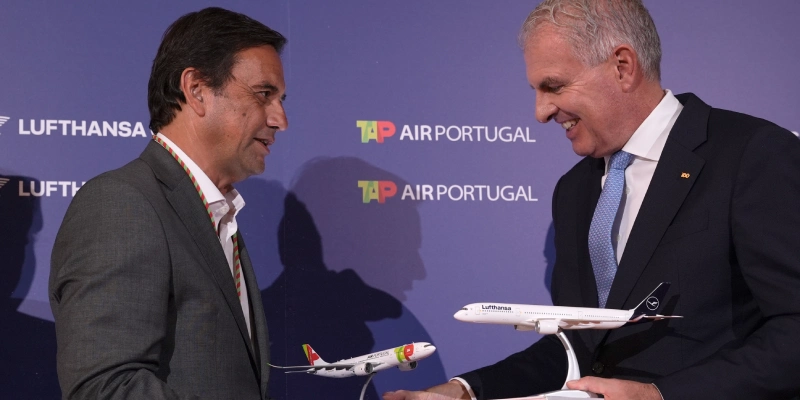




Lufthansa Group and the Portuguese government have signed a landmark agreement for the acquisition of an initial 44.9% minority stake in TAP Air Portugal. The deal, finalized at Lisbon’s Humberto Delgado Airport, marks a significant milestone in the flag carrier’s privatization process and will establish the German group’s seventh hub, substantially strengthening its transatlantic footprint into Latin America.
Financial Structure and Transaction Valuation
The transaction involves a strategic investment fully funded by the German aviation group’s own cash reserves:
- Initial purchase price: €1.025 billion for a 44.9% equity stake.
- Financing: Fully funded through Lufthansa Group’s available liquidity.
- Expanded shareholding: The equity holding could reach up to 49.9% through the potential acquisition of shares initially offered to TAP employees.
- Potential total cost: Factoring in a commitment fee, the total acquisition cost could rise up to €1.2 billion.
- Projected synergies: The minority stake will allow the group to capture the majority of estimated synergies, valued at up to €450 million.
The Lufthansa Group has explicitly expressed support for a potential full privatization of the Portuguese carrier, noting that a majority stake would accelerate TAP’s growth, bolster its market competitiveness, and unlock additional upside across the wider group.
→ Lufthansa Launches Nonstop Flights Between Frankfurt and Kuala Lumpur, Malaysia
Network Expansion: Lisbon as Seventh Hub and Latin American Leap
At the core of the growth strategy lies the complementarity of both route networks. The integration will position Lisbon’s Humberto Delgado Airport as Lufthansa Group’s seventh network hub, while Porto, the Azores, Madeira, and the Algarve remain integral components of the broader expansion plan.
Strategic Connectivity and Market Share
- Priority corridors: Capacity expansion between Portugal and Brazil, Lusophone Africa, and North America.
- Europe–Latin America traffic: A high-value strategic priority for the Lufthansa Group. Its current market share on this corridor, hovering around 9%, will surge to approximately 20% following the integration with TAP, bringing the group on par with its primary direct legacy competitors.
Corporate Vision: Portuguese Heritage and Long-Term Commitment
Carsten Spohr, Chairman of the Executive Board and Chief Executive Officer of Deutsche Lufthansa AG, remarked on the transaction:
“Today’s signing is an excellent signal pointing toward our shared future with TAP Air Portugal and the continued development of the Lufthansa Group. Our route networks complement each other perfectly, unlocking new growth avenues in Portugal and, most notably, across South America and Brazil. Alongside TAP’s workforce, we aim to build on the carrier’s success story, protect its Portuguese brand identity, and develop Lisbon as a core Lufthansa Group hub. We are consistently executing our European consolidation strategy while reaffirming our long-term commitment to Portugal. I want to thank the Portuguese government for managing a highly professional privatization process and for their partnership built on mutual trust. We look forward to deepening our cooperation with Portugal and shaping the future alongside TAP.”
Industrial Footprint and Economic Impact in Portugal
The Lufthansa Group holds an industrial track record spanning more than 70 years in Portugal:
- Current flight operations: Group carriers operate 353 weekly flights across six Portuguese destinations, representing a 75% increase over 2019 baseline levels.
- Workforce: More than 500 skilled professionals are currently employed across various Lufthansa Group entities in Portugal.
- Technical investment and MRO employment: Groundbreaking began this past June on a new Lufthansa Technik facility in Santa Maria da Feira, near Porto. Through this project, the group expects to exceed 1,000 direct jobs in the country by 2030.
The definitive closing of the transaction remains subject to customary closing conditions and the receipt of applicable regulatory approvals, particularly from the European Commission.
Related Topics

Boeing Projects China’s Commercial Fleet Will More Than Double, Surpassing 9,800 Aircraft Over the Next 20 Years
Air India Eyes Expanded Widebody Orders and Projects Near-Term Profitability

Pakistan Closes Airspace to Taiwanese Carriers in Unprecedented Move Aligned With Beijing

Alaska Airlines to Connect Anchorage and Tokyo Narita with Nonstop Boeing 737 MAX Flights
Plataforma Informativa de Aviación Comercial con 13 años de trayectoria.