Plus Ultra to Fly Exclusively to Venezuela: Airline Prepares Pre-Insolvency Proceedings and Deep Restructuring
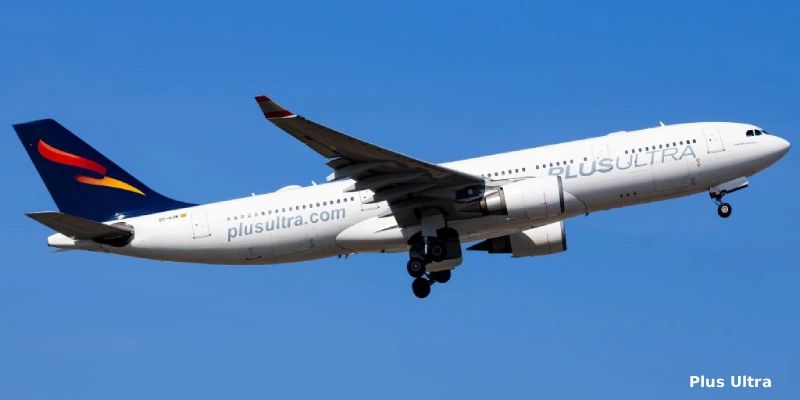




Spanish carrier Plus Ultra is preparing for a sweeping restructuring and pre-insolvency proceedings following severe financial losses. This drastic overhaul aims to ensure the airline’s survival by operating solely its routes to Venezuela alongside its aircraft leasing business for third-party carriers.
Operational and Workforce Impact: An Unprecedented Downsizing
Financial headwinds triggered by surging fuel prices have pushed the airline to the brink. To weather this crisis, management has decided to scale back operations to a bare minimum through the following measures:
- Pre-insolvency proceedings and workforce reduction: The company is preparing a collective redundancy plan (ERE) on organizational grounds, which will affect the majority of its current workforce of 679 employees.
- Closure of facilities: The downsizing will directly impact its two Madrid-based sites: the corporate headquarters in Alcobendas and its operational base at Adolfo Suarez Madrid-Barajas Airport, according to the UGT labor union.
- Cancellation of scheduled routes: Ticket sales for Lima (Peru) and Buenos Aires (Argentina) have been pulled from the airline’s website after being deemed economically unsustainable. While no definitive date has been set for the cessation of these flights, the move will slash its scheduled commercial block hours by 61%.
→ Iberia Completes Starlink In-Flight Internet Rollout Across Its Entire Airbus A321XLR Fleet
Profitability Havens: Venezuela and the ACMI Model
Despite halting most of its scheduled services, Plus Ultra will keep two business lines active that it still considers viable:
- Spain–Venezuela connections: Flights from Madrid and Tenerife to the South American nation will be preserved. The carrier justifies this decision based on the lower cost of jet fuel in Venezuela, a factor that allows it to contain primary operating expenses on long-haul routes.
- Leasing business (ACMI): The airline will maintain its Aircraft, Crew, Maintenance, and Insurance (ACMI) wet-leasing operations unchanged. Under this model, commercial risk and fuel expenses are borne by the lessee airline, resulting in significantly lower exposure to rising crude oil prices.
Financial Catalyst: Jet Fuel Costs and Balance Sheet Imbalances
The primary catalyst behind this crisis has been jet fuel cost overruns, which climbed to €105 million compared to the €69 million budgeted. This variance generated losses of €31 million during the first six months of its fiscal year 2027 (between February and August).
Although fiscal year 2024 (ended January 31, 2025) closed with revenues of €215 million (a 13.4% year-on-year increase), an EBITDA of €12 million, and a net profit of €2.5 million, the structural balance sheet carried underlying liabilities. At the beginning of 2025, Plus Ultra posted negative shareholders’ equity of €40.5 million, accumulated prior-year losses of €45.2 million, and total liabilities of €167 million against total assets of €126.1 million.
Burden of the SEPI Bailout and Judicial Investigation
The airline’s financial sustainability is heavily compromised by the €53 million state bailout received in March 2021. The funds came from the Solvency Support Fund for Strategic Enterprises (FASEE), managed by Spain’s state industrial holding company (SEPI), and were structured as a €19 million ordinary loan and a €34 million participating loan.
Five years later, the company has paid €12 million in interest but has yet to repay any of the principal. Negotiations to restructure the amortization schedule are currently stalled, awaiting a response from SEPI’s leadership in February once a new government is formed following the November 29 general elections.
Simultaneously, the state aid is at the center of a major judicial probe. Spain’s Anti-Corruption Prosecutor’s Office and the National Court (Audiencia Nacional) are investigating alleged money laundering offenses linked to an international network involving illicit funds from Venezuela, as well as influence peddling, criminal organization, and document forgery. The investigation is also examining potential political lobbying by associates of former Spanish Prime Minister Jose Luis Rodriguez Zapatero in securing the bailout—allegations that those involved have denied.
Failed Search for Investors and Leadership Overhaul
Aiming to consolidate control, secure an industrial partner, and inject liquidity, Executive Chairman and founder Julio Martinez Sola acquired a 64.3% stake in the carrier in October 2025. Approaches were made to three potential investors, including Laser Airlines and tour operator Avoris.
However, talks collapsed following the arrests of Martinez Sola and CEO Roberto Roselli in December 2025 as part of the money laundering investigation. After both executives were released under precautionary measures, company leadership was assumed by pilot Hugo Castano, previously a minority shareholder.
Plus Ultra now faces a critical juncture in which its immediate priority is no longer fleet growth or expansion into new Latin American markets. With the suspension of its flagship routes to Peru and Argentina and deep workforce cuts, the carrier is shrinking its footprint to a commercial bare minimum to cling to the only operations it currently deems economically sustainable.
Related Topics

FAA Lifts Nationwide Ground Stop in the U.S. Following Communications Outage

Argentina: Ezeiza Airport Reopens Main Runway Following Renovation Works

United Airlines Opens New Concourse E at Washington Dulles International Airport
Operations Gradually Normalize at Bogota and Rionegro Airports Following Radar Display System Outage

Un apasionado por la aviación, Fundador y CEO de Aviación al Día.