GE Aerospace Successfully Completes Ground Tests of Hybrid-Electric Engine for Narrowbody Aircraft
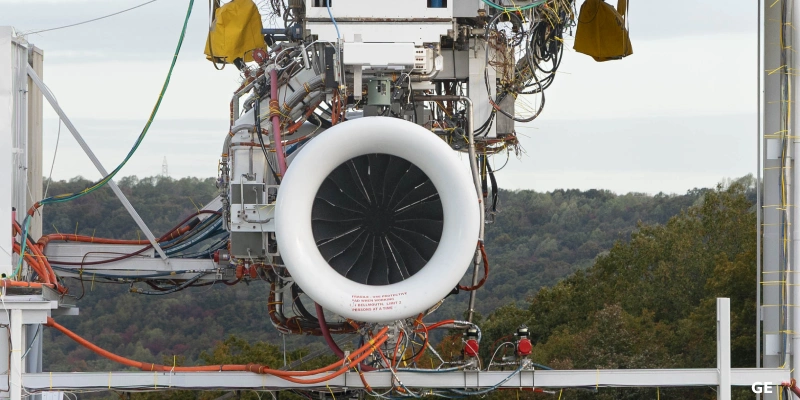




GE Aerospace has taken a concrete and measurable step toward the partial electrification of commercial aviation by successfully completing a series of ground tests for a hybrid-electric system integrated into a high-bypass turbofan engine, specifically targeting the narrowbody aircraft segment.
The testing not only confirms the technical viability of the concept but also exceeds performance parameters established by NASA. This is a critical data point for executives evaluating the real-world impact of these technologies on operating costs, efficiency, and range.
A Demonstration Beyond Individual Components
GE reported on Monday that the trials took place in 2025 at the Peebles Test Operation facilities. The tests utilized a modified Passport engine as part of NASA’s Turbofan Engine Power Extraction Demonstration project.
Unlike previous tests focused on isolated subsystems, this milestone validated three critical functions in an integrated manner:
- Power extraction
- Power transfer
- Electric power injection
This was achieved directly on a commercial high-bypass turbofan engine, allowing technical teams to delve into system integration and control—areas that have historically been complex in hybrid architectures.
→ How Airbus is Revolutionizing Aircraft Manufacturing with Titanium 3D Printing
Battery-Free Hybrid Architecture: A Strategic Choice
One of the most significant aspects of the announcement is that the demonstrated architecture does not require energy storage systems, such as batteries, to operate.
GE Aerospace is developing a solution that integrates electric motor-generators within the turbine engine itself, capable of supplementing power during various phases of operation. This approach offers several advantages:
- Reduces weight and complexity
- Avoids thermal and life-cycle limitations associated with batteries
- Provides greater flexibility to adapt to future aircraft designs
According to Arjan Hegeman, Vice President of Future of Flight at GE Aerospace, this advancement is a “critical step toward making hybrid-electric flight a reality for commercial aviation, with technologies that meet customers’ real needs for efficiency, durability, and range”.
NASA Validates Fuel Savings Potential
A key takeaway for the industry is that the results surpassed the technical benchmarks defined by NASA. These parameters, established with direct input from the industry, aim for engine capabilities that:
- Generate significant savings in fuel costs
- Meet the energy requirements of future commercial aircraft
Direct Connection to the CFM RISE Program
The power extraction project is part of the technological ecosystem of the CFM International RISE (Revolutionary Innovation for Sustainable Engines) program. Launched in 2021, RISE is one of the industry’s most extensive technology demonstration programs, featuring:
- Over 350 tests conducted
- More than 3,000 endurance cycles completed
- Evaluations of architectures such as Open Fan, compact core, and hybrid-electric systems
The program’s objective is ambitious but clearly defined: achieving more than a 20% improvement in fuel consumption compared to current commercial engines, while prioritizing safety, durability, and efficiency. RISE technologies are now moving toward ground and flight tests later this decade.
A Decade of Hybrid Expertise
This latest milestone is not an isolated event; GE Aerospace has accumulated over ten years of development in hybrid-electric propulsion:
- 2016: Ground test of a propeller driven by an electric motor.
- 2022: The world’s first test of a megawatt-class, multi-kilovolt hybrid system under simulated altitude conditions up to 45,000 feet.
- 2025: Announcement of a strategic alliance and investment in BETA Technologies to develop a hybrid turbogenerator for the Advanced Air Mobility (AAM) market.
For an industry seeking to reduce consumption and emissions without sacrificing range or reliability, this trial marks a turning point that warrants close attention.
Related Topics
Airbus Invests £150 Million in the UK to Accelerate A321 Production Ramp-Up
Airbus Posts 9% Rise in Aircraft Deliveries Through August, Stays on Track for Full-Year Target
Airbus Forced to Slow A330neo Deliveries After Finding Tool Inside Aircraft’s Horizontal Stabilizer

Airbus Workers in Spain Launch Indefinite Strike

Un apasionado por la aviación, Fundador y CEO de Aviación al Día.