Electra Unveils Turboelectric Commercial Airliner Concept Under NASA’s AACES 2050 Program
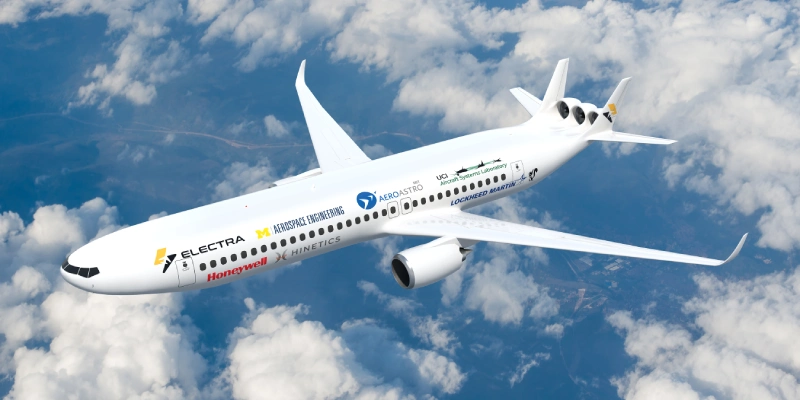




Electra, a leader in hybrid-electric aviation, has unveiled a new commercial aircraft conceptual design developed as part of National Aeronautics and Space Administration’s (NASA) Advanced Aircraft Concepts for Environmental Sustainability (AACES) program. This study analyzes how targeted electrification, advanced aerodynamics, and integrated airframe-propulsion design can radically transform the efficiency and competitiveness of 100+ passenger aircraft by mid-century.
A Disruptive Architecture Tailored to the Real World
Electra’s new concept is founded on the vision that the airline industry is entering a third era of flight, driven by electric propulsion technologies that enable entirely innovative yet viable aircraft architectures. Unlike its nine-passenger EL9 model—designed for ultra-short takeoffs and landings (eSTOL) under a Direct Aviation model—this concept for the AACES 2050 program scales the technology to a high-capacity, single-aisle aircraft, optimizing efficiency without disrupting compatibility with current airport operations.
The design stands out due to the following technical innovations:
- “Double-Bubble” Fuselage: A wider structure that allows the aircraft body itself to generate increased aerodynamic lift.
- Advanced Hybrid Propulsion: Features two underwing turbofan engines that generate both traditional thrust and the electrical power required to feed the electric tail fans.
- Boundary Layer Ingestion (BLI): Rear-mounted fans absorb and re-energize the slower-moving airflow traveling over the fuselage, optimizing overall aerodynamic performance.
According to company analysis, this configuration can deliver up to a 17% improvement in efficiency over and above the gains already projected for the year 2050 through advanced structures, traditional engine improvements, and conventional aerodynamic optimizations.
Operational Viability and Passenger Experience
A key premise of the project is its immediate integration into existing infrastructure. According to the concept’s designers, the goal is to avoid reliance on utopian, paper-only technologies and focus instead on aircraft that can actually be built, certified, and operated.
- Infrastructure Compatibility: The aircraft is designed to fit perfectly into current airport boarding gates and operate under airlines’ traditional logistical frameworks.
- Fuel Flexibility: It will utilize standard jet fuel or Sustainable Aviation Fuel (SAF), eliminating the immediate need for costly airport electric charging networks or unproven fuels.
- Optimized Interior Design: The double-bubble configuration enables a twin-aisle cabin layout within a narrowbody aircraft category, which will elevate passenger comfort and streamline boarding and deplaning times.
The research has been led by Dr. Alejandra Uranga, Chief Engineer for Research and Future Concepts at Electra, who previously co-led NASA-sponsored research at the Massachusetts Institute of Technology (MIT) that laid the groundwork for the original D8 double-bubble design.
An Open Ecosystem for Aeronautical Research
Beyond the aircraft design itself, Electra has developed 11 technical papers exhaustively documenting the models, methods, and conclusions of the study. Additionally, the firm adopted NASA’s open-source multidisciplinary design and optimization tool, Aviary, supplementing it with the development of an electric aircraft design suite intended for public use.
To execute the AACES 2050 project, Electra coordinated a multidisciplinary team of industry and academic leaders, including:
- American Airlines
- Honeywell Aerospace
- Lockheed Martin Skunk Works
- Hinetics
- The MIT Department of Aeronautics and Astronautics
- The University of Michigan Department of Aerospace Engineering
- The University of California, Irvine Aircraft Systems Laboratory
The Runway to 2050
NASA’s AACES 2050 program aims to examine technological concepts that will shape commercial aviation in the 2040s and 2050s. Electra’s proposal provides a short-to-medium-term electrification pathway that complements other industry approaches focused on new fuels and alternative architectures.
However, maturing this technology will require a joint effort. Corporate strategy leadership warns that the industry will not be able to consolidate this concept in isolation by 2050. A NASA-accelerated technology initiative will be required between now and 2035, focused on three pillars: the development of a double-bubble experimental aircraft (X-plane), integrated multi-megawatt generators, and kilovolt-class power distribution systems. Should these milestones be achieved, the industry will be positioned to introduce these capabilities into definitive commercial service by mid-century.
Related Topics
Avolon Orders 250 Aircraft from Airbus and Boeing
Airbus A321XLR: Reshaping Transatlantic Routes and Replacing Boeing 757
Biman Bangladesh Airlines Signs Order for 10 Airbus Jets
Airbus Picks Up Pace: Delivers 72 Aircraft in September Despite Quality Snags

Un apasionado por la aviación, Fundador y CEO de Aviación al Día.