
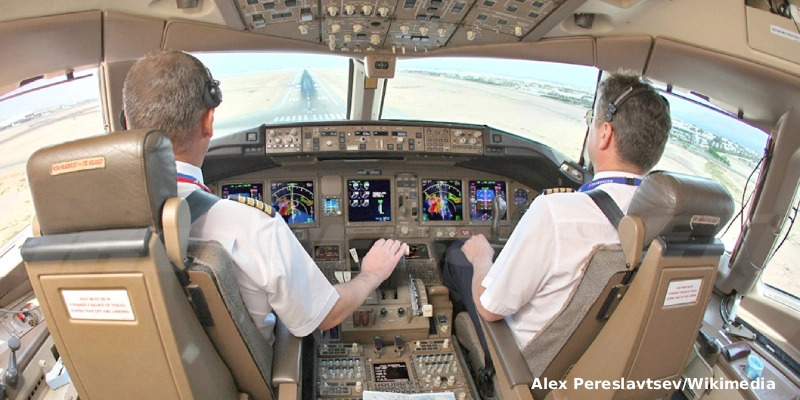
The recent escalation of strikes between the United States, Israel, and Iran has transformed some of the world’s busiest air corridors into high-risk environments. Commercial pilots must now navigate through airspace saturated by hundreds of ballistic missiles and strike drones—a situation that is pushing both operational safety and crew mental health to the limit.
A Hostile Operating Environment in the Middle East
The ongoing crisis in the Middle East has triggered temporary closures of critical airports and massive disruptions to passenger flows.
- Impact on Infrastructure: Retaliatory actions from Tehran have impacted airport operations, resulting in the suspension of numerous flights at major logistics hubs such as Dubai, Abu Dhabi, and Doha.
- In-flight Incidents: An Air France flight intended to repatriate French citizens from the United Arab Emirates was forced to abort its mission last Thursday due to missile fire.
- Precautionary Diversions: A Lufthansa pilot diverted a scheduled route from Riyadh to Cairo on Friday, citing regional security concerns.
Despite the severity of the situation, a limited flow of passenger traffic continues.
Psychological Challenge: “We Are Not Military Pilots”
The accumulation of conflicts in regions such as Ukraine, Afghanistan, and Israel has significantly increased pilot workload. Tanja Harter, President of the European Cockpit Association (ECA), noted that commercial pilots lack the specialized training required to confront military-grade threats in the air.
This constant exposure to external hazards generates fear and anxiety, forcing airlines to implement peer-support programs to protect the mental health of their personnel. According to Harter, the industry is facing a reality where airspace must be shared involuntarily with active weaponry.
→ Emirates to Complete Retrofit of First High-Density Airbus A380 in April
Technological Threat: Drones and GPS Spoofing
Airspace safety has degraded over the last two and a half years due to a combination of technical and kinetic warfare factors:
- GPS Spoofing: There has been a recorded increase in malicious tactics designed to deceive aircraft navigation systems regarding their actual position.
- Undetectable Drones: Unlike commercial aircraft, drones do not transmit signals via transponders (the device that identifies an aircraft to radar), making them nearly invisible to pilots.
- Radar Limitations: Conventional airport surveillance radars (ASR) struggle to detect small objects, and specialized detection technology is typically restricted to military or law enforcement use.
In the United States, the firm Dedrone reported over 1.2 million drone violations in 2025, a trend expected to rise globally. In Europe, airports including Stockholm, Munich, and London-Gatwick have already experienced operational shutdowns due to drone sightings.
Tactics and Operational Reality
Pilots with experience in the Middle East have developed mitigation strategies, though they acknowledge that total safety guarantees do not exist.
- Higher Altitude Flights: To counter the threat of Man-Portable Air-Defense Systems (MANPADS)—shoulder-fired missiles that typically reach up to 15,000 feet—pilots are increasing their cruise altitudes to remain out of range.
- Fuel Reserves: Aircraft are frequently carrying additional “contingency fuel” to allow for prolonged emergency diversions.
- Cockpit Management: During critical phases of flight, the workload is so high that pilots often lack the time to emotionally process external threats until the flight has concluded.
Moritz Burger, a commercial pilot based in Germany, described “near-miss” encounters with unknown objects (resembling balloons or drones) where reaction times are as short as one or two seconds, making evasive maneuvers virtually impossible.
The aviation industry currently faces a scenario with limited options. According to Tim Friebe, Vice President of the Air Traffic Controllers European Unions Coordination (ATCEUC), the only effective measure currently available when drones are detected is a total airport closure. As long as conflicts persist and drone technology continues to proliferate without technical detection regulations, the pressure on pilots and passenger safety will remain at critical levels.
With information from Reuters
Related Topics

Southwest Unveils Record-Breaking Summer 2027 Schedule With Major Expansion in Austin, Nashville, and San Diego

Alaska Airlines Challenges Delta in Seattle, Taking its Offensive to Long-Haul Routes

JetBlue Expands Colombian Network With Nonstop Fort Lauderdale–Barranquilla Flights

US Seeks to Accelerate Aircraft Type Certification


Plataforma Informativa de Aviación Comercial con 13 años de trayectoria.