Was Controller Workload a Determining Factor in LaGuardia Collision Between an Air Canada Jet and a Fire Truck?
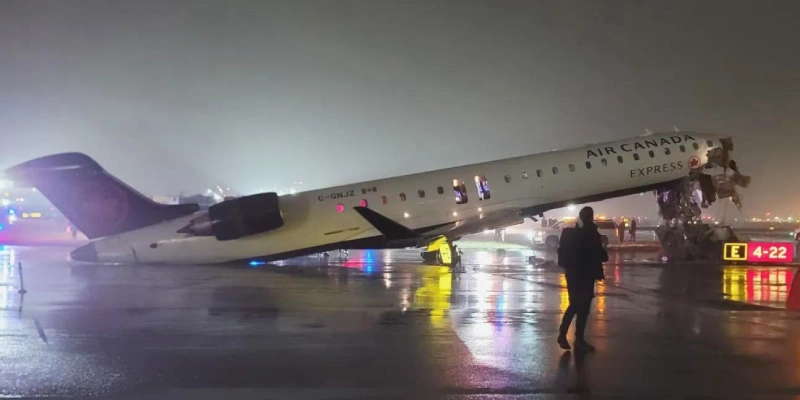




The tragic collision between an Air Canada Express jet and a fire truck at LaGuardia Airport has reignited the debate over operational safety and air traffic controller workload. Experts and active personnel suggest that traffic volume and a lack of support staff were critical factors in the accident, which claimed the lives of two pilots.
Higher-Than-Normal Traffic Volume
On the night of the accident, the New York airport faced operational saturation caused by weather-related delays. Between 10:00 p.m. and 11:37 p.m.—the time the Bombardier CRJ-900 impact occurred—70 commercial flights were recorded taking off or landing.
This figure significantly exceeds the average of 53 flights for that same period on Sundays in March since 2022, and it is more than double the 31 flights originally scheduled for that night. Previous meteorological reports indicated the presence of atmospheric and surface icing, a condition that slows traffic flow and creates a backlog of operations.
Critical Factor: Combining Tower Positions
One of the central points of controversy is the staffing levels in the control tower. During the event, only two controllers were on duty in the tower.
- Workload: According to an analysis of audio from LiveATC.net, the involved controller appeared to be simultaneously handling Local Control (runways) and Ground Control (movement of vehicles and taxiing aircraft).
- Protocols in Question: Following a similar collision in 1997, the National Transportation Safety Board (NTSB) established that Ground and Local positions should not be combined before midnight at LaGuardia. Currently, it is unclear whether that procedure remains in effect.
- Official Version: U.S. Secretary of Transportation Sean Duffy defended the facility’s staffing, stating that the airport has 33 certified controllers and six in training, nearing its target of 37.
→ Star Alliance Launches Ninth Star Connection Centre at Los Angeles International Airport
Simultaneous Emergency and Communication Error
The high-pressure situation was further aggravated by an emergency declared by a United Airlines flight, which reported an unusual odor on board after aborting two takeoffs due to failures in its anti-ice system.
Amidst managing this emergency, the controller cleared a fire truck to cross the runway, without noticing it was in the path of the Air Canada Express jet. In the recovered audio, the controller can be heard unsuccessfully trying to stop the vehicle and, subsequently, admitting in a distressed voice: “I messed up.”
NTSB Investigation and Next Steps
The National Transportation Safety Board (NTSB), led by Jennifer Homendy, keeps the investigation open and has noted that it is premature to rule out any factor. The inquiry will focus on:
- Reviewing the standard operating procedures (SOPs) of the LaGuardia control tower.
- Determining why the controller was not immediately relieved of duty after the accident, as is standard practice.
- Analyzing whether fatigue or traffic density prevented an effective response to the runway incursion.
The aviation sector remains attentive to the final findings, which could force a re-evaluation of required staffing levels at high-density metropolitan airports during weather contingencies.
Related Topics
LATAM Airlines Strengthens Regional Leadership with Five Honors at the 2026 World Travel Awards

Copa Airlines Restores Operations Following Seismic Activity in Panama and Expands Commercial Flexibility Policies

Arajet Resumes Direct Flights Between Punta Cana and Guayaquil

LATAM Airlines Announces Nonstop Flights Between Santiago de Chile and Caracas Starting in January

Plataforma Informativa de Aviación Comercial con 13 años de trayectoria.