First Qantas Airbus A350-1000ULR for “Project Sunrise” Rolls Off Final Assembly Line in Toulouse
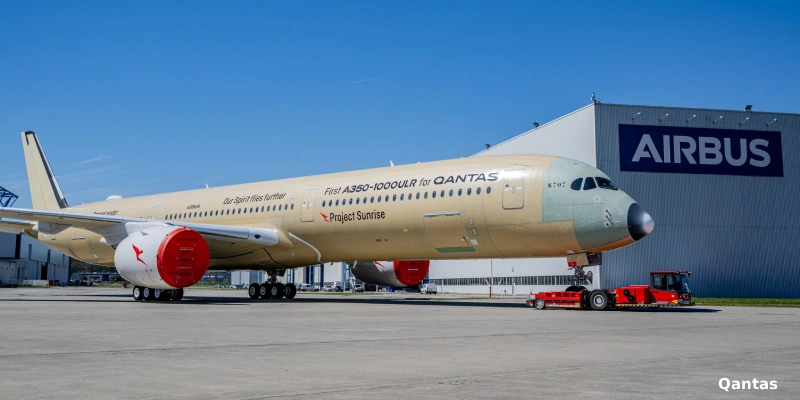




Qantas has unveiled images of its first Airbus A350-1000 specifically designed for the ambitious “Project Sunrise.” This aircraft, which will enable non-stop flights from Sydney to London and New York, marks the beginning of the final phase to eliminate stopovers on the world’s longest routes.
Roll-out in Toulouse: The “Ultra-Long-Range Leader” Takes Shape
On Sunday, April 12, the first Airbus A350-1000 Ultra-Long-Range (ULR) destined for Qantas rolled off the final assembly line in Toulouse, France. The aircraft was presented with its Rolls-Royce Trent XWB-97 engines already installed.
This same airframe had been spotted in November 2025 without engines, sporting decals identifying it as the “ultimate long-range leader.” Following this rollout, the aircraft will enter a ground testing phase before beginning an Airbus flight certification program expected to last approximately two months.
Engineering for the 22-Hour Flight
To fulfill the mission of connecting Australia’s east coast with London and New York non-stop, the A350-1000ULR incorporates significant technical modifications:
- Fuel Capacity: An additional 20,000-liter center-rear fuel tank has been installed, essential for sustaining operations of up to 22 hours.
- Optimized Cabin Configuration: Unlike standard configurations that exceed 300 seats, Qantas has limited capacity to 238 passengers.
- Enhanced Comfort: This reduction aims to maximize personal space and comfort on ultra-long-haul flights.
- Time Savings: These direct routes are estimated to save up to four hours of travel time compared to alternatives requiring a stopover.
→ Qantas and American Airlines Secure Provisional Authorization in Australia for Transpacific Alliance
In-Flight Well-being: Ending the “Tyranny of Distance”
Qantas Group CEO Vanessa Hudson emphasized that “Project Sunrise” will fundamentally change the way customers travel. The cabin design is the result of a collaboration between industrial designer David Caon and sleep science specialists from the Charles Perkins Centre at the University of Sydney.
Passenger Experience Features:
- Wellbeing Zone: A dedicated space for passengers to perform stretching exercises and hydrate.
- Specialized Lighting: Systems designed to combat jet lag through light cycles that help the body adapt to new time zones.
- Scientific Approach: The design is based on data gathered during previous test flights that analyzed the physical impact of ultra-long-haul travel on crew and passengers.
A Tribute to History: “Double Sunrise”
The project’s name pays tribute to the historic “Double Sunrise” flights operated by Qantas during World War II. Those missions were carried out using Consolidated Catalina flying boats between Perth and Sri Lanka, lasting long enough for the crew to see two sunrises.
In honor of that heritage, Qantas plans to name each of the 12 Airbus A350-1000s from its original order after stars or constellations. The four original Catalina aircraft were named Antares, Arcturus, Rigel, and Spica.
Next Steps and Entry into Service
Once Airbus testing is concluded and the airline accepts the aircraft, it will fly to Sydney’s Kingsford-Smith International Airport later this year.
Before officially launching “Project Sunrise” routes in March 2027, the A350 will temporarily operate on Qantas’ short and medium-haul network. This period will serve for crew training and ground staff familiarization with the new model, ensuring a smooth transition toward direct flights to London Heathrow and John F. Kennedy (JFK) early next year.
Related Topics
End of an Era: Lufthansa Retires Airbus A340-600 Fleet After 23 Years of Service

ITA Airways Celebrates Its Fifth Anniversary
Condor Launches Daily Flights Between Berlin and Abu Dhabi

Lufthansa in Talks to Acquire Remaining 50.1% Stake in TAP Air Portugal Following Initial Entry

Plataforma Informativa de Aviación Comercial con 13 años de trayectoria.