
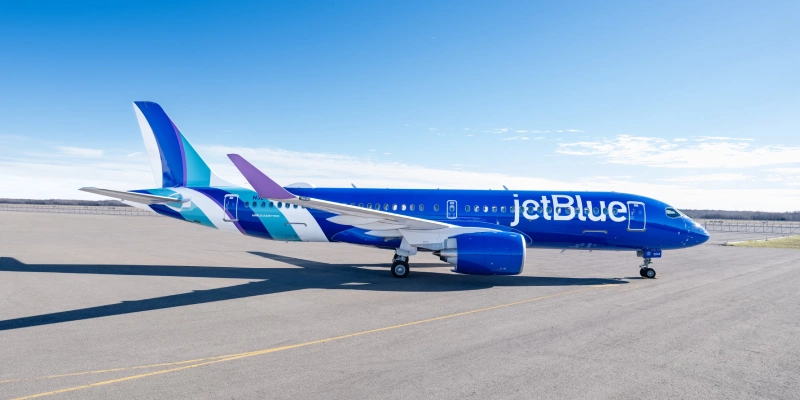
JetBlue Airways has announced plans to reduce its operational capacity, freeze hiring, and increase ticket prices. These measures aim to mitigate the impact of soaring fuel costs following a first-quarter loss in 2026 that exceeded market expectations.
Geopolitical Impact on Operating Costs
The financial stability of JetBlue Airways has been compromised by critical external factors. The conflict resulting from the U.S. and Israeli attack on Iran led to the closure of the Strait of Hormuz, a vital artery transporting nearly one-fifth of the world’s oil and gas supplies.
This disruption has triggered extreme volatility in the energy sector. During the first quarter, jet fuel prices rose approximately 15% year-over-year. For the second quarter, the New York-based carrier projects an average price per gallon between $4.13 and $4.28, a figure significantly higher than the $2.40 recorded during the same period last year.
First Quarter Financial Results
Despite a complex macroeconomic environment, the company’s operating revenues showed signs of resilience:
- Total Revenue: Reached $2.24 billion, a 4.7% year-over-year increase.
- Revenue per Available Seat Mile (RASM): This key metric for measuring pricing power increased by 6.5%.
- Adjusted Loss: The airline reported a loss of $319 million (86 cents per share), higher than the 71 cents per share forecasted by analysts.
→ Airbus Modernizes JetBlue’s Airbus A320s with Next-Generation Flight Deck Displays
Decisive Actions: Capacity and Revenue Management
CEO Joanna Geraghty emphasized that the airline is taking measures within its control to counter volatility. Key actions include:
- Capacity Reduction: Following a 1.7% decrease in the first quarter, JetBlue plans additional cuts during periods of low demand in the second half of the year.
- Revenue Optimization: Fare increases will be implemented with the goal of recovering between 30% and 40% of additional fuel costs in the second quarter, targeting a full recovery by early 2027.
- Labor Discipline: The airline will slow the pace of hiring to align with new capacity expectations.
Strength in Premium Segments and Liquidity
Despite the challenges, JetBlue shares rose 2.4% following the report. This optimism reflects solid demand in premium segments and the airline’s strategic expansion in Florida.
Regarding financial health, Geraghty dismissed any rumors of a potential bankruptcy, asserting that the company possesses ample liquidity. Recently, JetBlue secured a $500 million debt financing commitment backed by 22 aircraft, with an option to obtain an additional $250 million using more planes as collateral.
Challenges on the Horizon
The transformation plan initiated in 2024—focused on cost control, route optimization, and deferring aircraft deliveries—now faces pressure from ultra-low-cost carriers (ULCCs).
Analysts at TD Cowen suggest that the possibility of a government bailout for the ULCC segment could create competitive uncertainty and pressure JetBlue’s stock value in the short term. Nevertheless, management remains firm in its objective to restore operational and financial stability by 2027.
Related Topics

Akasa Air in Talks With Boeing for Over 200 737 MAX Jets
Embraer Nears Key Regional Jet Order from Japan Airlines

AirAsia Co-Founder Defends Airline’s Liquidity Amid Fuel Surge and Rules Out State Bailout

Korean Air and Boeing Finalize Historic Order for 103 Aircraft Valued at $36.2 Billion


Plataforma Informativa de Aviación Comercial con 13 años de trayectoria.