Turkish Airlines Invests $2.3 Billion in Istanbul Airport to Boost Operational Capacity in Cargo, Maintenance, and Catering
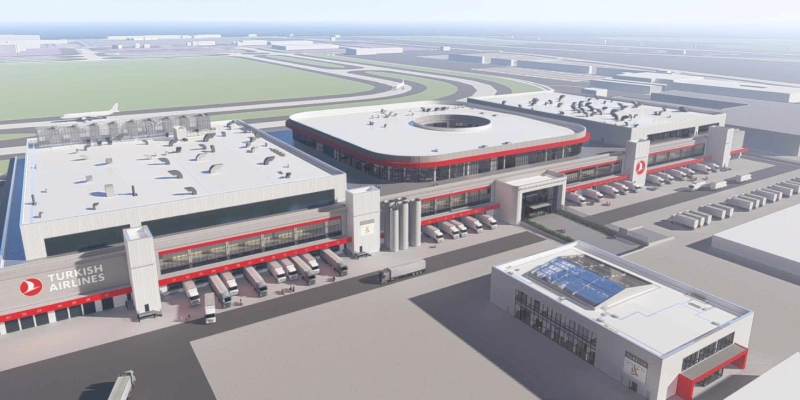




Turkish Airlines has launched one of the most ambitious infrastructure investment programs in its recent history. The airline announced a plan valued at over 100 billion Turkish lira (approximately $2.32 billion), designed to strengthen its operational capacity in air cargo, maintenance, catering, training, and digital resilience, at a time when fleet growth demands an industrial base on the same scale.
The program is directly aligned with Vision 2033, the strategic roadmap with which the company is preparing to celebrate its centennial as Turkey’s flag carrier. In total, the plan includes eight major projects, distributed across various locations, but with a clear focal point: Istanbul Airport as the core of the group’s operational ecosystem.
Groundbreaking ceremonies were held this week and were attended by high-ranking government officials and airline executives, underscoring the strategic importance of the project for both Turkish Airlines and Turkish aviation as a whole.
Air Cargo: SmartIST Aims to Compete Globally
Doubling Capacity to Compete with the World’s Major Hubs
The most visible pillar of the program is the expansion of cargo operations. Turkish Airlines will proceed with the second phase of the SmartIST terminal at Istanbul Airport, a project that will more than double the annual handling capacity from 2.2 million tons to 4.5 million tons.
Once completed, the complex is set to rank among the world’s largest air cargo hubs, reinforcing Istanbul’s ambition as a key connection point between Europe, Asia, Africa, and the Middle East.
The SmartIST expansion will be carried out in stages, with deliveries expected throughout 2027 and 2028, allowing demand growth to be matched with the progressive commissioning of new capacities.
→ Southwest Partners with Turkish Airlines to Offer Transatlantic Flights Starting in January
Maintenance and Engines: Turkish Technic as an Industrial Hub
A New State-of-the-Art Engine MRO Center
The second major focus of the investment is on technical services and maintenance, through the subsidiary Turkish Technic. The most significant project is the construction of a new engine maintenance center, scheduled for completion in 2027.
The facility will be equipped to support Rolls-Royce Trent XWB-84 and XWB-97 engines, which power the Airbus A350, as well as the Trent 7000 for the A330neo. According to the airline, the center will position itself among Europe’s largest next-generation engine MRO facilities, expanding both internal capacity and third-party offerings.
More Hangars, More Heavy Maintenance Aircraft
In parallel, Turkish Airlines plans to open new aircraft maintenance hangars in 2026. These facilities will increase simultaneous heavy maintenance capacity by around 20%, with space to work on up to 12 aircraft at the same time.
This reinforcement is key to sustaining fleet growth and reducing external dependencies in a context of high pressure on the global MRO market.
Catering and Logistics: Industrial Scale for a Global Airline
Catering for Over Half a Million Daily Passengers
The investment also extends to support infrastructure. Turkish Airlines will build a new main catering center, scheduled to enter service between 2027 and 2028. The facility will have the capacity to serve meals to more than 500,000 passengers per day, positioning it among the largest airline catering operations in the world.
E-commerce and Door-to-Door Cargo
In the logistics domain, the airline will open a dedicated e-commerce complex in 2026, designed to support its Widect platform, which offers integrated door-to-door cargo services. The goal is to strengthen Turkish Airlines’ role in global trade flows and capitalize on the sustained growth of cross-border e-commerce.
Training and Digital Resilience: Invisible but Critical Infrastructure
Beyond physical assets, the program includes investments in digital infrastructure and training, two areas increasingly critical for operational continuity.
A new data center is planned, with completion expected in the second half of the decade. This center will support flight operations, maintenance planning, and commercial systems, with enhanced levels of security and data management.
In parallel, Turkish Airlines will advance with a new flight training center, whose first phase will enter service in 2026–2027, to support pilot and crew training as operations expand. Additionally, a new crew terminal building will be constructed at Istanbul Airport, also expected to be delivered in 2026, aimed at optimizing workflows between flight operations, handling, and maintenance.
Economic Impact and Long-Term Vision
The Chairman of the Board and the Executive Committee, Ahmet Bolat, emphasized that the core objective is to ensure that fleet growth is accompanied by sufficient infrastructure and qualified personnel. According to the airline, the program will generate around 26,000 new jobs in 2026 alone, a figure that will increase to 36,000 positions once all phases are completed.
Ahead of its centennial in 2033, Turkish Airlines is not just expanding facilities. It is building, in Bolat’s words, “an ecosystem” designed to support a larger, more resilient airline, with Istanbul established as a top-tier global hub for aviation and the Turkish economy.
The implementation timeline, alignment with fleet evolution, and market absorption capacity will now be the key points to watch in a program that, in scale and ambition, marks a turning point in the recent history of the group.
Related Topics

Boeing Pays $3.1 Million FAA Fine over Multiple Safety Violations
American Airlines Unveils First Reconfigured Boeing 777-300ER Featuring New Flagship Suite
Southwest Reveals Plans for Its First Lounge Network in Partnership with Chase

United Begins Gate Delivery Testing for Food and Essential Items at Newark Airport

Plataforma Informativa de Aviación Comercial con 13 años de trayectoria.