Lufthansa Revives Its Legacy: Iconic “Parable” Design Returns to the Skies for Centenary




As it celebrates the 100th anniversary of its founding, Lufthansa is not only looking toward the future but also deliberately reflecting on its past to highlight the milestones that defined its identity as a global airline. The result is a blend of heritage marketing, technical precision, and aeronautical symbolism, brought to life through aircraft painted in historic liveries and large-scale special designs.
An Airbus A321 Linking the 1950s with Modern Aviation
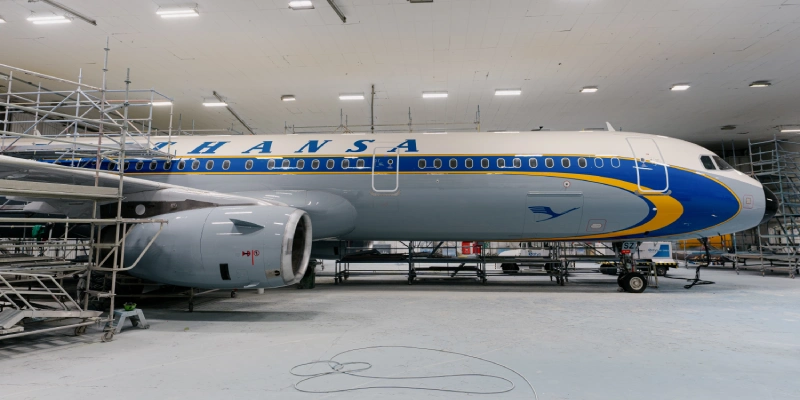
This Tuesday, Lufthansa awaits the arrival of an Airbus A321-200 (registration D-AISZ) in Frankfurt. The aircraft was repainted in Norwich, United Kingdom, featuring the company’s historic “Parable” design. The plane is scheduled to perform special flight LH9898 and is expected to land at the main German hub around 2:45 p.m. local time.
The A321, typically used for short- and medium-haul operations, now sports a livery that recalls the golden age of post-war commercial aviation. The “Parable” design, introduced by Lufthansa in the mid-1950s, was inspired by the aerodynamic lines of the 1930s. It sought to convey dynamism, speed, and a vision of the future during an era when flying was still a privilege reserved for the few.
This graphic element was not limited to the aircraft themselves. At the time, the “parabola” became an omnipresent feature of the Lufthansa brand, appearing on luggage tags, commercial documentation, and flight schedules, reflecting a visual coherence that was uncommon for the era.
→ Lufthansa Begins Modernization of Business Class on Its Airbus A380 Fleet
Legacy of the Lockheed Super Star and the Birth of Premium Travel
The choice of this design is no coincidence. Nearly 70 years after its first flight with Lufthansa, the livery returns to the skies as a tribute to the Lockheed L-1649A Super Star, which joined the fleet in 1957.
This aircraft marked a turning point in the airline’s history for two key reasons:
- It was the first model to offer Senator Class, the most exclusive way to travel at the time.
- It was primarily focused on non-stop connections to New York, solidifying Lufthansa’s presence in the strategic transatlantic market.
As part of this historical commemoration, a restored Lockheed L-1649A Super Star will soon be exhibited alongside a Junkers Ju 52 at the new Lufthansa Group Hangar One. This group conference and visitor center at Frankfurt Airport is scheduled to open in April.
XXL Centenary Fleet Continues to Grow in Munich and Frankfurt
The celebration is not limited to a single aircraft. The so-called “anniversary fleet,” recognizable by its XXL-sized crane logo, continues to expand.
On Monday, an Airbus A350-900 painted entirely in blue (registration D-AIXL) landed at the Munich hub after being repainted in Châteauroux, France. This marks the third aircraft to feature this special scheme.
Currently, the commemorative fleet includes:
- 1 Boeing 787-9, based in Frankfurt
- 1 Airbus A320neo, also based in Frankfurt
- 1 Airbus A350-900, assigned to the Munich hub
The plan goes even further. Lufthansa has confirmed that at least the following aircraft will adopt the centenary design in the coming weeks:
- 1 Airbus A380
- 1 Boeing 747-8
- 1 Airbus A350-1000
Beyond the visual appeal for enthusiasts and “spotters,” this initiative reveals a deeper meaning. Lufthansa is utilizing its history as a strategic asset, reinforcing values of continuity, reliability, and technological leadership at a time when the industry is undergoing a structural transformation defined by sustainability, fleet renewal, and global competitive pressure.
Related Topics
Peru Conditionally Approves Abra Group’s Acquisition of Sky Airline
Arajet Announces New Direct Route Between Montevideo and Punta Cana

Passenger Traffic in Latin America and the Caribbean Dropped 2.3% in June: First Monthly Contraction Since 2021

LATAM Voted “Favorite Airline in Central and South America” by Millennial and Gen Z Travelers

Un apasionado por la aviación, Fundador y CEO de Aviación al Día.